How to play Wave Lab
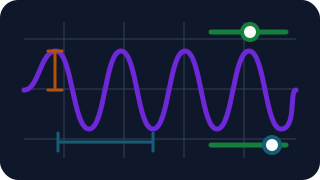
Wave Lab is a GCSE physics game about waves, wave speed and the electromagnetic spectrum. At the top of the game, a wave moves across a grid. Two sliders change its frequency and its wavelength, and the wave redraws as you move them.
Below the wave you answer ten questions, each with four options. Some ask you to use the wave speed equation, v = f λ, to find a speed, a frequency or a wavelength. Others ask for the period of a wave, or for the wavelength or amplitude of the wave on the grid. The rest cover the electromagnetic spectrum: the order of its parts, and what each part is used for.
The values come with prefixes such as kHz, MHz, cm and nm, and speeds are often in km/s. Convert them before you calculate. In the wave speed questions, the first three of the round give lengths in metres, the middle four use centimetres and the last three use nanometres. The harder start skips the metres. The questions that ask you to read the grid draw a new wave and lock the sliders, so the grid shows the wave you need to measure.
You have 15 seconds for each question. A right answer in time scores 15 points. When the time runs out, the question counts as wrong. With the practice switch on there is no timer, and a right answer scores 10. After a wrong answer, the game shows the right one before you move on.
The science behind wave speed and the spectrum
A wave carries energy from one place to another. Its frequency is the number of waves that pass a point each second, in hertz (Hz). Its wavelength is the distance from a point on one wave to the same point on the next, such as crest to crest. The amplitude is the largest distance a point moves away from its rest position. The wave in the game is transverse: each point moves up and down while the wave travels along the grid.
Wave speed links frequency and wavelength: wave speed = frequency × wavelength, or v = f λ. A wave of 5 Hz with a wavelength of 2 m travels at 10 m/s. To find the frequency, divide the speed by the wavelength. To find the wavelength, divide the speed by the frequency. The wave speed equation page shows the equation in the form each board prints it.
The period is the time for one whole wave to pass. It is 1 divided by the frequency, T = 1 ÷ f, so a 4 kHz wave has a period of 1 ÷ 4,000 = 0.00025 s. AQA 8463 lists this equation in 4.6.1.2.
Prefixes are behind a lot of wrong answers. 1 kHz is 1,000 Hz and 1 MHz is 1,000,000 Hz. 1 cm is 0.01 m and 1 nm is 0.000000001 m. A speed of 1 km/s is 1,000 m/s. The game offers the answer you would get without converting, so check every unit first.
Light is one part of a continuous electromagnetic spectrum. From the longest wavelength to the shortest, which is also from the lowest frequency to the highest, the order is radio waves, microwaves, infrared, visible light, ultraviolet, X-rays and gamma rays. AQA gives this order in 4.6.2.1, Edexcel 1PH0 in 5.10 and 5.11, and OCR J249 in P5.2.
Each part of the spectrum has uses. The uses in the game come from the specifications. For example, Edexcel 1PH0 point 5.22 lists airport security scanners for X-rays and sterilising medical equipment for gamma rays, and AQA 8463 lists uses in 4.6.2.4.
Tips for wave speed questions
- Write v = f λ before you start. To find v, multiply. To find f or λ, divide.
- Change every value into Hz, m and m/s before you put it in the equation.
- To read a wavelength off the grid, measure from one crest to the next crest. Measuring half a wave is a common slip.
- Amplitude goes from the middle line up to a crest. If you measure from a crest down to a trough, you get twice the amplitude.
- For the spectrum, fix one end in your head. Radio waves have the longest wavelength and the lowest frequency, and gamma rays have the shortest wavelength and the highest frequency.
Try the sliders between questions. Make the wavelength longer and you can see the crests spread out along the grid.
Use this in the classroom
Wave Lab suits Years 9 to 11 in lessons on wave properties and the electromagnetic spectrum. A round of ten takes five to ten minutes.
Before a round, show the wave on the board and move one slider at a time. Ask the class to say what changes on the grid. Then play a round together, and ask students to write the conversion for each prefix before anyone picks an option.
The spectrum questions work as a quick recall check at the end of a lesson. For groups who find prefixes hard, set Unit Sprint first. The practice switch gives students who need more time a round with no clock.
No sign-up is needed. The page for teachers has more on using the games in class.
Similar games
For more practice with this equation and others, play Equation Rearranger. The physics equation sheet lists every GCSE physics equation, and the all games page has the rest of our games.
Questions people ask
These are common questions about wave speed and the electromagnetic spectrum.
How do you calculate wave speed?
Multiply the frequency by the wavelength: v = f λ. Use hertz and metres, and the answer comes out in metres per second.
What is the order of the electromagnetic spectrum?
From the longest wavelength to the shortest: radio waves, microwaves, infrared, visible light, ultraviolet, X-rays and gamma rays. Frequency goes the other way, so gamma rays have the highest frequency.
What is the difference between frequency and period?
Frequency is how many waves pass a point each second. Period is how long one wave takes to pass. Each is 1 divided by the other, so a wave with a frequency of 2 Hz has a period of 0.5 s.
Is the wave speed equation on the GCSE equation sheet?
Yes. In the 2025, 2026 and 2027 exams, all three boards print it on the equation sheet. You still need to choose v = f λ, rearrange it and convert the units yourself.