How to play Electrolysis Products
Electrolysis Products is a free GCSE chemistry game about electrolysis. In electrolysis, an electric current splits an ionic compound into elements. Each question names a compound and asks what forms at one of the two electrodes. An electrode is a rod that carries the current into the liquid. You pick one answer from four.
A round has ten questions in three stages. Questions 1 to 3 use molten compounds, which means compounds melted by heating. Questions 4 to 7 use solutions, where the compound is dissolved in water. Questions 8 to 10 ask which ions move to each electrode, and some ask you to choose a half equation. If you tick the harder start, you begin with solutions and reach the ion stage at question 4.
A right answer earns 10 points. Answer inside 15 seconds and you earn 5 more. The clock only takes away the bonus, so you can still answer when it runs out. Practice mode switches the clock off. After each answer, the game shows the rule that decides it.
The science behind electrolysis
An ionic compound is made of ions. An ion is an atom, or a group of atoms, that carries an electric charge. When you melt an ionic compound or dissolve it in water, its ions are free to move about. The liquid can then conduct electricity. A liquid like this is called an electrolyte.
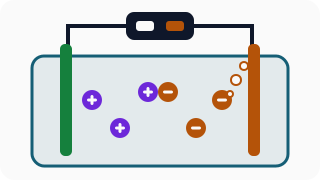
Pass a current through an electrolyte and the ions start to move. Positive ions go to the negative electrode, called the cathode. Negative ions go to the positive electrode, called the anode. At the electrodes the ions are discharged, which means they lose their charge and form elements. The game uses inert electrodes, which do not react themselves.
A molten compound holds only two kinds of ion, so the rule is short. The metal forms at the cathode and the non-metal forms at the anode. Molten lead bromide gives lead and bromine. Molten zinc chloride gives zinc and chlorine. AQA names zinc chloride as a safer choice than lead bromide for practical work in school.
A solution also contains water. Some water molecules break down into hydrogen ions (H⁺) and hydroxide ions (OH⁻), so each electrode has two kinds of ion that could react. At the cathode, you get hydrogen if the metal is more reactive than hydrogen. So sodium chloride solution gives hydrogen, not sodium. Copper is less reactive than hydrogen, so copper chloride solution gives copper. At the anode, you get oxygen unless the solution holds halide ions such as chloride. Then the halogen forms instead. Chloride solutions give chlorine, and sulfate solutions give oxygen. You can check these gases with the tests on our tests for gases page.
At the cathode, positive ions gain electrons. A gain of electrons is called reduction. At the anode, negative ions lose electrons, and a loss of electrons is called oxidation. A half equation shows one of these changes, with each electron written as e⁻. For hydrogen, the half equation is 2H⁺ + 2e⁻ → H₂. For oxygen, it is 4OH⁻ → O₂ + 2H₂O + 4e⁻.
This topic sits in AQA 8462 section 4.4.3 and AQA 8464 section 5.4.3. On both AQA courses, half equations at the electrodes are Higher Tier only. Edexcel 1CH0 and 1SC0 cover electrolysis in points 3.22 to 3.29, and OCR Gateway J248 covers it in C3.4.
Tips for electrolysis questions
- Read the stage heading first. Molten sodium chloride and sodium chloride solution both show NaCl, but they give different products at the cathode.
- For a molten compound, split it into its metal and its non-metal. The metal always goes to the cathode.
- For a solution, ask yourself two things. Is the metal more reactive than hydrogen? Does the solution contain a halide ion?
- What forms is an element, such as Cl₂. An answer with a charge on it, such as Cl⁻, is still an ion.
- In a half equation, add up the charges on each side. The totals must match, just like the atoms.
Not sure where a metal sits compared with hydrogen? Learn the order on our reactivity series page before your next round.
Use Electrolysis Products in the classroom
Electrolysis Products suits Years 9 to 11 once a class has met ionic compounds. A full round takes about five minutes, so it works as a starter or to close a lesson.
Before the practical on solutions, put one solution question on the board. Ask pairs to predict the product at each electrode and to name the rule they used. After the practical, let the class play a full round and ask which question caught them out.
Higher Tier groups on AQA can focus on the half equation questions. Ask them to explain why each wrong equation fails. It may have the electrons on the wrong side, too few electrons, or the wrong ion. Practice mode helps anyone who needs more time to think. If the class needs a reminder of how ions form, start with our ionic bonding guide.
Similar games
The cathode rule depends on how reactive the metal is, and you can practise that order in Reactivity Rank. To see where the charges on ions come from, try Inside the Atom. For full symbol equations, play Balance It.
Questions about electrolysis
Here are short answers to common questions on electrolysis.
How do you predict the products of electrolysis?
First check whether the compound is molten or dissolved in water. If it is molten, the metal forms at the cathode and the non-metal at the anode. In a solution, hydrogen forms at the cathode if the metal is more reactive than hydrogen. Oxygen forms at the anode unless the solution has halide ions, when the halogen forms.
Why does sodium chloride solution give hydrogen instead of sodium?
Water in the solution provides hydrogen ions. Sodium is more reactive than hydrogen, so hydrogen forms at the cathode instead of sodium. At the anode you get chlorine, because chloride is a halide ion.
Which ions move to the cathode during electrolysis?
Positive ions move to the cathode, which is the negative electrode. Negative ions move to the anode, which is the positive electrode. When the ions reach an electrode, they are discharged and form elements.
Are electrolysis half equations Higher Tier only?
On AQA Chemistry 8462 and AQA Combined Science Trilogy 8464, yes. Both mark half equations at the electrodes as Higher Tier only. If you study Edexcel or OCR, check your own specification.