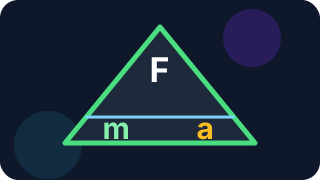
How to play Equation Rearranger
Equation Rearranger is a game for practising GCSE physics equations. Each question gives you an equation and asks you to find one quantity in it. You do that in two steps.
First you pick the rearranged equation, with the quantity you want on its own on the left. Then you use it. The game gives you values for the other quantities, and you pick the right answer from four choices.
Each answer has a number and a unit, and both have to be right. Some values come with a prefix, such as kW or cm, so convert them before you calculate.
A round has ten questions. The first few use short equations such as F = m a. Later ones bring in squares, square roots and standard form. If that start feels too easy, choose the harder start on the first screen.
When you get a step wrong, the game shows the working, so you can see where it went off track. Press Next when you are ready.
The science behind rearranging physics equations
Every GCSE physics course asks you to change the subject of an equation and to put numbers into it with the right units. AQA (8463), Edexcel (1PH0) and OCR (J249 and J259) all list both as maths skills in their specifications.
Changing the subject means getting the quantity you want on its own. You do the same thing to both sides of the equation until it is alone. For P = I V, to find the current you divide both sides by V, which gives I = P ÷ V.
Equations with three or more quantities work the same way, one step at a time. For E_p = m g h, height is h = E_p ÷ (m g). You divide by both m and g, which is the same as dividing by their product.
Squares take one more step. Kinetic energy is E_k = ½ m v². To find the speed, first get v² on its own: v² = 2 E_k ÷ m. Then take the square root. Forgetting the square root is one of the most common mistakes, so the game offers it as a wrong answer to catch you.
Units matter as much as the algebra. The equations only work in SI units: metres, kilograms, seconds, joules, watts, amps, volts and ohms. A power of 2 kW is 2,000 W, a mass of 500 g is 0.5 kg, and 3 minutes is 180 seconds. If you put 2 into P = I V instead of 2,000, your answer comes out 1,000 times too small.
You no longer need to learn the equations by heart for the exam. For exams in 2025, 2026 and 2027, every board gives students a sheet with all the physics equations on it, and the sheets carry on after that. What the sheet can't do is rearrange an equation for you or convert your units. From 2028 the exam boards must also avoid questions that only ask you to copy an equation off the sheet, so knowing how to use each one counts for more.
You can read what each board publishes on its own website. AQA's GCSE Physics specification lists the equations in its appendix.
Every answer in this game is worked out twice, once by the game and once by a separate test, before the game goes live. The about page explains how we check the science. If you think an answer is wrong, tell us on the contact page.
Tips for rearranging equations
- Write down the quantity you want before you start. It is easy to rearrange for the wrong one.
- Check your rearranged equation by putting simple numbers in. If F = m a and you think a = m ÷ F, try m = 2 and F = 10. You get 0.2, but the answer should be 5.
- Convert every value into its base unit before you calculate: kilo means × 1,000, milli means ÷ 1,000, and centi means ÷ 100.
- If the equation has a square in it, expect a square root when you undo it.
- Look at the size of your answer. A person running at 800 m/s is a sign that something went wrong.
Speed only earns a small bonus, so it is fine to take your time. Getting the method right every time is worth more than being fast.
Use this in the classroom
Equation Rearranger suits Years 9 to 11 and works as a starter, a plenary or a homework task. A round of ten takes about five minutes.
For a starter, show the game on the board and ask the class to write the rearranged equation on mini whiteboards before anyone picks an option. The wrong options come from mistakes students really make, so they are worth discussing. Ask why the square root version is right and the others are wrong.
The practice switch turns the timer off, which helps students who need more thinking time. For a set that finds the start too easy, use the harder start, which begins with the longer equations.
Students don't need an account, and the game works on phones and Chromebooks. The page for teachers has more ideas, and the list of what we collect explains how student data is handled. Parents can read how the site works at home.
Similar games
You can find every game on the all games page. For maths practice with the same equations, our sister site has Speed Distance Time and Density Mass Volume.
Questions people ask
These are the questions students and teachers ask most about rearranging physics equations.
What is the easiest way to rearrange a physics equation?
Do the same thing to both sides until the quantity you want is on its own. If it is multiplied by something, divide both sides by that. If it is squared, take the square root at the end.
Do I need to memorise physics equations for GCSE?
Not for exams in 2025, 2026 or 2027. AQA, Edexcel and OCR give every student a sheet with all the physics equations on it, and the sheets continue after that. You still need to choose the right equation, rearrange it and use the right units.
Why is my answer 1,000 times too big or too small?
Usually a value had a prefix that was not converted. Change kilowatts to watts, grams to kilograms and kilojoules to joules before you put the numbers in.
Which years is Equation Rearranger for?
It suits Years 9 to 11 studying GCSE physics or combined science. Year 9 students can start at the normal level, and Year 11 students can try the harder start.