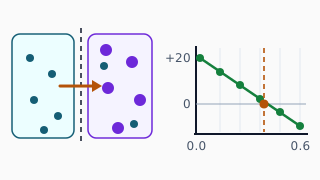
How to play Osmosis Lab
Osmosis Lab is a free GCSE biology game about osmosis and the other ways substances move into and out of cells. A round has ten questions in three steps. In the first step, you tell diffusion, osmosis and active transport apart. You also predict which way water moves when a cell or a piece of potato sits in a sugar solution.
In the second step, you get a mass before and a mass after, as in the potato practical. You work out the percentage change in mass to 1 decimal place. The last step shows a graph of change in mass against the concentration of the sugar solution. You find where the line crosses zero, or you say whether the tissue gained or lost mass at a marked concentration.
Every question has a bonus clock of 15 seconds. A right answer earns 10 points, or 15 if you answer in time. Press 1 to 4 to choose an answer and Enter to go on. Tick Harder start to skip the first step and go straight to the sums and graphs. Practice mode hides the clock, and the game keeps a separate best score for the harder start.
The science behind osmosis
Substances cross cell membranes in three ways. The first is diffusion, the spreading out of particles in a solution or a gas. The net movement is from a higher concentration to a lower one. Net movement means more particles go one way than the other. AQA gives oxygen, carbon dioxide and urea as examples. Diffusion is faster with a bigger difference in concentration, a higher temperature or a larger membrane surface area.
Osmosis is the diffusion of water. Water moves from a dilute solution to a concentrated solution through a partially permeable membrane. A dilute solution has only a little substance dissolved in it. A partially permeable membrane lets some particles through and stops others. Root hair cells take in water from the soil by osmosis.
Active transport moves substances the other way, from a more dilute solution to a more concentrated one. We call this moving against the concentration gradient. It needs energy from respiration. Root hairs use it to take in mineral ions from the soil, and the gut uses it to move sugar into the blood.
Plant tissue gains mass in a solution that is more dilute than its cells, because water moves in. In a more concentrated solution, it loses mass. In the practical, you weigh pieces of potato, leave them in a range of sugar or salt solutions, then weigh them again. Percentage change is the change in mass ÷ the starting mass × 100. Then you plot the results against concentration. Where the line crosses zero, the tissue neither gains nor loses water. Edexcel says this lets you find the sugar concentration inside the potato.
This topic is AQA 8461 and 8464 section 4.1.3. The potato practical is required practical 3 in AQA Biology and required practical 2 in AQA Combined Science. Edexcel 1BI0 and 1SC0 cover it in 1.15 to 1.17, with core practical 1.16. OCR J247 has it in B2.1a.
Tips for osmosis questions
- Water moves overall towards the more concentrated solution.
- Compare the two numbers you are given. If the solution outside has less sugar than the cells, water moves in.
- Subtract the starting mass from the final mass. If the tissue got lighter, your answer is negative.
- Divide by the starting mass, never the final mass, then multiply by 100.
- On the graph, no change in mass is where the line crosses 0 %. It is not where the line meets the side axis.
- Water moves by osmosis. If an answer says the cells pump water using energy, it describes active transport.
Use this osmosis game in the classroom
Osmosis Lab suits Years 9 to 11 when you teach transport in cells, and it works well around the potato practical.
Before the practical, play the first step together. Ask the class to predict which potato pieces will gain mass and which will lose it. After the practical, set the percentage step as a check on their own sums. Each wrong option comes from a real mistake, such as dividing by the final mass. Ask students to explain what went wrong in each one.
The graph step suits the lesson where students write up their results. Many students read the answer from the point where the line meets the side axis. The graph questions include that wrong option, so you can start a class talk from it.
Practice mode turns the clock off for students who need more time. Nobody signs in to play. The page for teachers has more ideas for lessons, and what we collect explains the small amount of data the site keeps.
Similar games
Every one of these processes happens at the cell membrane. You can place the membrane and the other cell parts in Cell Builder. To practise measuring cells under a microscope, try Magnification Challenge. Enzyme Activity covers the enzymes that break food into small molecules, before the gut absorbs them. The biology guides explain plant and animal cells in more detail.
Osmosis questions
Here are answers to questions that teachers and students often ask about osmosis.
What is the difference between osmosis and diffusion?
Diffusion is the net movement of any particles from a higher to a lower concentration. Osmosis is the diffusion of water only. Water moves from a dilute solution to a concentrated one, through a partially permeable membrane.
How do you calculate percentage change in mass in the osmosis practical?
Take the starting mass away from the final mass. Divide the result by the starting mass, then multiply by 100. A piece that gets lighter gives a negative answer.
Why does a piece of potato gain mass in pure water?
Pure water is more dilute than the solution inside the potato cells. Water moves into the cells by osmosis, so the potato gets heavier.
How is active transport different from diffusion and osmosis?
Active transport moves substances from a more dilute solution to a more concentrated one, which is against the concentration gradient. It needs energy from respiration. Root hairs use it to take in mineral ions from very dilute solutions in the soil.