How to play Half-Life
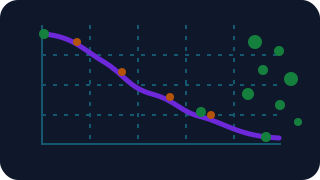
Half-Life is a GCSE physics game about radioactive decay. Each question shows a sample of nuclei as dots, and the dots disappear at random as the nuclei decay. Beside the sample is a graph of its activity against time, with a gridline at every half-life.
Each question has four options. You might read the half-life off the graph, or work out how many nuclei are left after a number of half-lives. Other questions ask what fraction is left, or how long the activity takes to fall to a target value. The last kind shows a nucleus that gives out an alpha or a beta particle, and you pick the balanced nuclear equation.
A round has ten questions, and any kind can come up at any point. As the round goes on, the samples get bigger and more half-lives pass. Tick the harder start to skip the smallest numbers.
The clock counts down from 15 seconds. A right answer scores 10 points, with 5 more if you answer before the clock reaches zero. After that you can still answer, and you only miss the bonus. The practice switch hides the clock. If you choose a wrong option, the game shows the method and the right answer.
The science behind half-life
Some atomic nuclei are unstable. They give out radiation and change into a different nucleus. This is radioactive decay, and it is random: nobody can say when one nucleus will decay. A large sample still follows a steady pattern. The dots in the game show this, because each sample decays in its own way but about half the dots have gone after each half-life. The half-lives in the game last a few seconds, so you can watch a sample decay while you answer.
The half-life is the time it takes for the number of unstable nuclei in a sample to halve. It is also the time it takes for the activity to fall to half its starting value. Activity is measured in becquerels (Bq). On a graph, halve the starting activity, read across to the curve, then read down to the time axis.
After each half-life, what is left halves again. Start with 512 nuclei, and after three half-lives you have 512 ÷ 2 ÷ 2 ÷ 2 = 64, which is 1/8 of the start. One common mistake is to take away the half-life value instead of halving. Another is to halve only once.
In alpha decay, the nucleus gives out an alpha particle, which is two protons and two neutrons, the same as a helium nucleus. The mass number goes down by 4 and the atomic number goes down by 2. In beta decay, a neutron turns into a proton and the nucleus gives out a fast electron. The mass number stays the same and the atomic number goes up by 1. In a balanced equation, the mass numbers on each side add up to the same total, and so do the atomic numbers.
AQA 8463 covers nuclear equations in 4.4.2.2 and half-life in 4.4.2.3. It tests the fall in activity as a ratio after a number of half-lives on Higher tier papers only, and it does not ask students to name the new element. The game shows element symbols anyway, taken from the periodic table, so you can match each atomic number to its element. Edexcel 1PH0 covers this topic in 6.20 to 6.27. OCR J249 has it in P6.1, and OCR J259 in P5.1.
Tips for half-life questions
- Halve, do not subtract. Each half-life divides what is left by 2.
- Count the fractions as you go: 1/2, 1/4, 1/8, 1/16. The bottom number doubles each time.
- To find a time, count how many halvings it takes to reach the target, then multiply by the half-life.
- Read the half-life where the activity is half its starting value. Where it is a quarter, two half-lives have passed.
- In a nuclear equation, add the top numbers on each side, then the bottom numbers. Both pairs of totals must match.
The atomic number decides the element. When it changes, the symbol has to change too.
Use this in the classroom
Half-Life suits Years 9 to 11 once students have met atomic structure. A round of ten takes about five minutes, so it works as a starter or a homework task.
Start with the sample on the board. Ask the class how many dots they expect after one half-life, then after two. Each new question brings a new sample that decays in a different way, which leads into why decay is random while the half-life stays the same.
For the nuclear equations, give students a periodic table and ask them to write the new nucleus on mini whiteboards before they look at the options. Then ask them to check each option by adding the mass numbers and the atomic numbers on both sides. The practice switch removes the clock for students who need more time.
Students do not need an account. The what we collect page sets out what the site records, and the page for teachers has more ideas for lessons.
Similar games
To practise finding elements by atomic number, try Periodic Table Challenge. You can browse every other game on the all games page.
Questions people ask
Here are the questions students and teachers ask most about half-life.
How do you find the half-life from a graph?
Read the starting activity and halve it. Go across from that value to the curve, then down to the time axis. The time you read there is the half-life.
How much of a radioactive sample is left after 3 half-lives?
One eighth. Halve three times: 1/2, then 1/4, then 1/8. If a sample starts with 800 nuclei, 100 are left.
What happens to the mass number and atomic number in alpha and beta decay?
In alpha decay, the mass number falls by 4 and the atomic number falls by 2. In beta decay, the mass number stays the same and the atomic number rises by 1.
Why is radioactive decay called random?
Nobody can predict when a single nucleus will decay. In a large sample, though, close to half the nuclei decay in each half-life, so the half-life stays the same.