How to play Respiration Equations
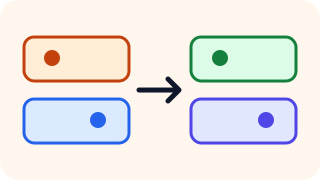
Respiration Equations is a free GCSE biology game where you build the aerobic and anaerobic respiration equation from word tiles. Each equation question gives you a bank of tiles: substance names, plus signs and an arrow. Tap the tiles in order, left to right, then press Check. Two tiles in each bank belong to a different equation, so read them all before you tap.
The game checks which side of the arrow each substance is on. The order of the substances on one side does not matter. Tap a tile in your equation to take it back out. A round has ten questions. The first three build the three equations: aerobic respiration, anaerobic respiration in muscles, and anaerobic respiration in plant and yeast cells. The next four ask where respiration happens, which kind transfers more energy, and whether breathing is respiration. Question eight has you match four chemical formulae to their names, and the last two are equations again.
The harder start skips the first three equations. It opens with the four questions about location, energy and breathing, then moves on to the formulae and more equations. The clock counts down from 15 seconds. A right answer scores 10 points, with 5 more if you beat the clock. The practice switch hides the clock.
The science behind the respiration equations
Respiration is a chemical reaction that goes on all the time in living cells. It transfers the energy that living things need, for example to move, keep warm and build larger molecules. It is exothermic, which means it gives out energy. Respiration is a different thing from breathing. OCR notes that many students mix up ventilation, which is moving air in and out of the lungs, with respiration.
Aerobic respiration uses oxygen. AQA prints its word equation as glucose + oxygen → carbon dioxide + water. It also lists the chemical symbols C₆H₁₂O₆, O₂, CO₂ and H₂O for students to recognise. AQA gives them as a list and does not join them into a balanced symbol equation, and Edexcel and OCR do not print one either.
Anaerobic respiration happens without oxygen. In muscles, AQA writes it as glucose → lactic acid. In plant and yeast cells it is glucose → ethanol + carbon dioxide, and in yeast this is called fermentation. The glucose is only partly broken down, so much less energy is transferred than in aerobic respiration. When muscles work hard and oxygen runs short, lactic acid builds up and creates an oxygen debt.
OCR's Biology B course (J257) also says where respiration happens: in the cytoplasm and mitochondria of animal and plant cells, and in the cytoplasm of microorganisms. The game asks about bacteria, which have no mitochondria, so respiration in bacteria happens in the cytoplasm.
AQA 8461 and 8464 cover this in 4.4.2.1, with oxygen debt in 4.4.2.2. Edexcel 1BI0 and 1SC0 ask you to compare aerobic and anaerobic respiration in 8.9 and 8.10 but print no equation. OCR J247 covers respiration in B1.3 and refers to the word equation without printing it. OCR J257 has the topic in B4.1. In KS3 science you learn a word summary of both kinds, including fermentation.
Tips for the aerobic and anaerobic respiration equations
- Every respiration equation in the game starts with glucose.
- Only aerobic respiration has oxygen on the left of the arrow.
- Lactic acid belongs to muscles. Ethanol and carbon dioxide belong to plant and yeast cells.
- The muscle equation has one product, so it has no plus sign.
- Ventilation is breathing. Respiration happens inside cells.
Put the starting substances before the arrow and the products after it. The order on each side does not matter, so carbon dioxide + water and water + carbon dioxide are both right. If a tile lands in the wrong place, tap it in your equation to send it back to the bank.
Use this in the classroom
Respiration Equations suits Years 9 to 11 when you teach respiration or revise bioenergetics. A round of ten takes about five minutes, so it fits a starter. The harder start suits a class that already knows the three equations and needs the location and energy questions.
Put the aerobic question on the board and ask the class to write the equation on mini whiteboards before anyone taps a tile. Then show the muscle question and ask what changes when oxygen runs out. The yeast question leads into bread making, which AQA gives as one use of fermentation.
The breathing question makes a quick check of understanding. Ask students to vote for ventilation or respiration before you show the answer. Then ask the students who chose respiration to say where in the body it really happens, and why a runner's muscles might make lactic acid.
If you teach photosynthesis next, Photosynthesis Lab uses the same kind of word tiles. The page for teachers has more lesson ideas, and the page for parents explains how the site works.
Similar games
To see where the mitochondria sit in a cell, try Cell Builder. For more work with chemical formulae, Periodic Table Challenge asks you to work out formula masses. Every game is on the all games page.
Questions people ask
Students and teachers often ask these questions about respiration.
What is the equation for anaerobic respiration?
It depends on the cell. In muscles, AQA writes it as glucose → lactic acid. In plant and yeast cells, it is glucose → ethanol + carbon dioxide. Neither one uses oxygen.
What is the word equation for aerobic respiration?
Glucose + oxygen → carbon dioxide + water. AQA prints it in that form. OCR J247 refers to it but does not print it, and Edexcel does not print a respiration equation at all.
What is the difference between aerobic and anaerobic respiration?
Aerobic respiration uses oxygen and makes carbon dioxide and water. Anaerobic respiration happens without oxygen. It makes lactic acid in muscles, or ethanol and carbon dioxide in plants and yeast. It transfers much less energy, because the glucose is only partly broken down.
Is breathing the same as respiration?
No. Breathing, or ventilation, moves air into and out of the lungs. Respiration is a chemical reaction in all living cells that transfers energy from glucose.