How to play Mole Ratio Rush
Mole Ratio Rush is a free moles calculation game for GCSE chemistry. Most moles work is Higher Tier, so the game carries a Higher Tier badge. Each question gives you some numbers and four answers, each with its unit.
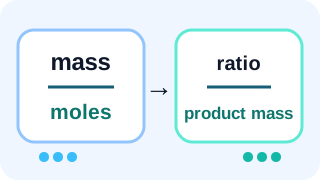
The round builds in three steps. Questions 1 to 3 give the mass of a substance in grams and ask how many moles it contains. Questions 4 to 7 show a balanced equation and an amount of one reactant in moles, and ask how many moles of a product form. Questions 8 to 10 give a mass of a reactant and ask for the mass of a product. A small diagram above the options shows which step you are on. The harder start skips the first step.
You get 15 seconds per question, and a right answer in that time earns 15 points. If the time runs out, that question counts as wrong. These questions take several steps, so practice mode can help: it turns the timer off, and each right answer earns 10. After a wrong answer, the game shows each step of the working.
The science behind moles calculations
Each element has a relative atomic mass, Ar, printed on the periodic table. Add up the Ar values of every atom in a formula and you get the relative formula mass, Mr. Water, H₂O, has two hydrogen atoms (Ar 1) and one oxygen atom (Ar 16), so its Mr is 18. Working out Mr is Foundation content: AQA 4.3.1.2 and Edexcel 1.43.
A mole is an amount of substance. One mole of anything contains 6.02 × 10²³ particles, a number called the Avogadro constant. The mass of one mole of a substance is its Mr in grams, so one mole of water has a mass of 18 g. To turn a mass into moles, divide by Mr. The game writes the amount in moles as n, so n = mass ÷ Mr. For 36 g of water, n = 36 ÷ 18 = 2 mol.
The numbers in front of the formulas in a balanced equation give the mole ratio. In H₂SO₄ + 2NaOH → Na₂SO₄ + 2H₂O, one mole of sulfuric acid makes two moles of water. So 3 mol of sulfuric acid makes 6 mol of water.
To find the mass of a product, put the steps together. Take 2HCl + Ca(OH)₂ → CaCl₂ + 2H₂O, and start with 146 g of hydrogen chloride. HCl has an Mr of 36.5, so 146 g is 4 mol. The ratio of HCl to CaCl₂ is 2 to 1, so 2 mol of calcium chloride forms. CaCl₂ has an Mr of 111, so the mass is 2 × 111 = 222 g.
AQA marks 4.3.2.1 to 4.3.2.3 as Higher Tier only. Edexcel covers moles in points 1.50 and 1.51, and OCR Gateway in C3.1g and C3.1h. Those two boards show Higher Tier points in bold, so check the tier for your course. The game uses the Ar values from the AQA GCSE periodic table. OCR's data sheet gives every value to one decimal place, such as 32.1 for sulfur, so your answer may differ slightly if you use another board's table.
Tips for moles questions
- Write the unit with every number: g for mass and mol for moles. The options all carry a unit, so read it before you choose.
- Work out Mr one atom at a time. A number after a bracket multiplies everything inside it, so Ca(OH)₂ has two oxygen and two hydrogen atoms.
- Take the ratio from the big numbers in front of the formulas, never from the small numbers inside them.
- To use a ratio, divide by the number in front of what you have, then multiply by the number in front of what you want.
- A mole of a substance is its Mr in grams. It is not always 12 g.
OCR Gateway's specification warns that many students think a mole and a mass are the same thing, and that phrases like one mole being 12 g of carbon make this worse. One wrong option in the product mass questions comes from this mistake.
Use Mole Ratio Rush in the classroom
Mole Ratio Rush is for Higher Tier groups in Years 10 and 11. Use it once students can work out Mr, either to start a moles lesson or to check the idea at the end. A round takes five to ten minutes.
Before a round, show the step diagram on the board and ask students what happens at each arrow. During the round, have them write each step on mini whiteboards before anyone taps an answer. The wrong options come from real slips, such as using the wrong substance's Mr or turning the ratio upside down, so ask students to explain how someone would reach each one.
For students who find the timer stressful, turn on practice mode. The page for teachers explains how to run the games in class, with no sign-up needed.
Similar games
Every equation here balances, and you can practise that step in Balance It. For relative formula mass practice, try Periodic Table Challenge. The reactions are all neutralisations, which pH Detective covers from the salt side. The all games page has the rest of our games.
Moles questions answered
Quick answers to what teachers and students ask about moles at GCSE.
How do you calculate moles from mass?
Divide the mass in grams by the relative formula mass, Mr. For example, 36 g of water has an Mr of 18, so it contains 36 ÷ 18 = 2 mol.
What is a mole ratio in a chemical equation?
It is the ratio of the numbers in front of the formulas in a balanced equation. In H₂SO₄ + 2NaOH → Na₂SO₄ + 2H₂O, the ratio of sulfuric acid to water is 1 to 2.
Are moles calculations only on the GCSE Higher Tier paper?
Mostly. AQA marks moles, mole ratios and reacting masses from moles as Higher Tier only. Edexcel and OCR show Higher Tier points in bold, so check your own course. Working out a relative formula mass is on the Foundation paper.
How do you find the mass of a product from a balanced equation?
Turn the reactant's mass into moles, use the mole ratio to find the moles of product, then multiply by the product's Mr to get its mass in grams.