How to play Spring Stretch
Spring Stretch is a free GCSE physics game about Hooke's law. The law says that the extension of a spring is proportional to the force on it, up to a point. Extension is how much longer the spring gets. Proportional means that if you double the force, the extension doubles too. A round has ten questions in three steps, and each one has four answers to pick from.
The first three questions give you two of these: force, spring constant and extension. You work out the third. Some extensions are in centimetres, so watch the units. The next four show a force-extension graph. You find the spring constant from the slope, pick the limit of proportionality, or decide if a spring went back to its original length. The last three ask how much energy a stretched spring stores.
Every question has a 15 second bonus clock. A right answer earns 10 points, plus 5 more if you beat the clock. Tick Harder start to begin with the graphs and then face seven energy questions. Practice mode turns the clock off. Choose an answer with a tap, a click or the keys 1 to 4, then press Next. The working appears as soon as you answer.
The science behind Hooke's law
To stretch a spring, you need two forces. You pull one end, and a hook or a hand holds the other end still. With only one force, the spring would just move along. Squashing and bending also need more than one force.
For a spring, force = spring constant × extension, or F = k e. Force is in newtons (N) and extension is in metres (m). The spring constant, k, tells you how stiff the spring is. Its unit is newtons per metre (N/m). A spring with k = 200 N/m needs 200 N to stretch it by 1 m, or 2 N to stretch it by 1 cm. The same equation works when you squash a spring, with e as the amount it gets shorter. Our spring force equation page shows how to rearrange it.
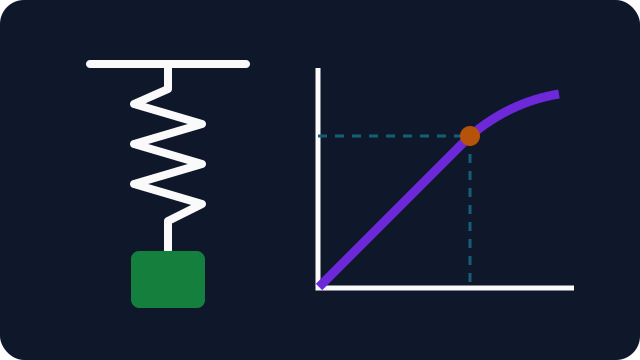
Plot force up the side of a graph and extension along the bottom. While the two are proportional, you get a straight line through zero. The slope of that line, called the gradient, is the spring constant. Pull harder and the line starts to curve. AQA calls the point where it bends the limit of proportionality. After it, F = k e no longer works. Edexcel and OCR describe the same change as a linear relationship turning non-linear.
A spring that goes back to its original length when you let go has had elastic deformation. Deformation just means a change of shape. If the spring stays longer, the deformation was inelastic. OCR calls this plastic deformation. A spring pulled too far ends up permanently stretched.
Stretching a spring takes work, and the spring stores that energy as elastic potential energy. You can work it out with Ee = ½ k e², as long as the spring stays within its limit of proportionality. Square the extension first, then multiply. The elastic potential energy page has worked examples.
This topic is in AQA 8463 section 4.5.3 and AQA Combined Science 8464 section 6.5.3. Edexcel 1PH0 and 1SC0 cover it in points 15.1 to 15.6, and OCR Gateway J249 in P2.3a to P2.3e. All three boards list F = k e as an equation to learn. They give you the energy equation in the exam. None of this is Higher tier only. Recent exam sheets have also printed F = k e, and you can compare them on our physics equation sheet page.
Tips for Hooke's law questions
- Change centimetres to metres before you use F = k e. Divide by 100, so 15 cm becomes 0.15 m.
- Multiply k by e only when you want the force. To find k, divide the force by the extension. To find the extension, divide the force by k.
- Check the unit on each answer. Force is in N, the spring constant in N/m, extension in m and energy in J.
- For energy, square the extension, multiply by k, then halve. Two easy slips are leaving out the half and forgetting to square.
- To find the limit of proportionality, lay a ruler along the straight part of the line. The last point still on the ruler is your answer.
- On a graph where the force goes on and then comes off, see where the dashed line meets the extension axis. Zero means elastic, and any gap means inelastic.
Use this Hooke's law game in the classroom
Spring Stretch suits Years 9 to 11 when you teach forces and elasticity. A round takes about five minutes, so it works as a starter or as a check at the end of a lesson.
It pairs well with the practical where students hang masses on a spring and measure the stretch. That is required practical 6 in AQA GCSE Physics, core practical 15.6 for Edexcel and part of PAG P2 for OCR. Before the practical, play the first step together to warm up on F = k e. Afterwards, set the graph step while students plot their own results. Ask them to find the spring constant of their spring from the gradient and to mark where their line starts to curve.
The energy step makes a quick homework task. Students who want more time can switch on practice mode, and nobody needs an account. The teachers page has more ideas for using the games in class.
Similar games
A stretched spring is one kind of energy store. Energy Stores has you follow energy as it moves from one store to another. To practise adding forces that act on one object, play Resultant Force. For turning forces on a beam, try Moments Balance.
Questions about Hooke's law
Short answers to common questions about springs, stretching and Hooke's law.
What is Hooke's law?
Hooke's law says the extension of a spring is directly proportional to the force on it. This holds as long as you stay within the limit of proportionality. As an equation, F = k e, where k is the spring constant.
How do you find the spring constant from a force-extension graph?
Put force on the vertical axis and extension on the horizontal axis. Pick a point on the straight part of the line, and divide its force by its extension. That gradient is the spring constant in N/m. Make sure the extension is in metres.
Do I need to remember F = k e for GCSE physics?
Yes. AQA, Edexcel and OCR all list F = k e as an equation you should be able to recall. The elastic potential energy equation, Ee = ½ k e², is one you apply, and it appears on the equation sheet in the exam.
What is the difference between elastic and inelastic deformation?
After elastic deformation, an object goes back to its original shape and size when you remove the force. After inelastic deformation, it stays changed. A spring that you pull too far stays a little longer than before.