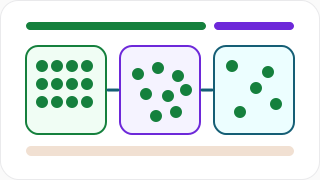
How to play Solid, Liquid, Gas
Solid, Liquid, Gas is a free KS3 science game about the particle model. The particle model says that all matter is made of tiny particles. The way the particles are arranged, how they move and how close they sit explain how solids, liquids and gases behave. Each question asks you to pick one answer.
Questions 1 to 3 show one particle diagram, and you name the state: solid, liquid or gas. Questions 4 to 7 show a before diagram and an after diagram. You name the change of state between them. Questions 8 to 10 ask why something happens, and you pick the statement that explains it with particles. With the harder start ticked, you begin with changes of state and reach the explaining questions at question 4.
You score 10 points for each right answer, plus 5 bonus points if you answer inside 15 seconds. When the bonus time runs out, you can still finish the question. The timer button above each question turns the clock off. After you answer, the game shows the reason.
The science behind the particle model
In a solid, the particles are packed close together in a regular pattern. They stay in fixed places, so a solid keeps its shape. In a liquid, the particles are still close together, but they can move past each other. That is why a liquid flows and takes the shape of its container. In a gas, the particles are far apart and move quickly in all directions, so a gas spreads out to fill any container.
The spacing of the particles also explains density. Density tells you how much mass is packed into a given space. A gas has far fewer particles in each cubic centimetre than a solid or a liquid, so its density is much lower. The particles themselves stay the same size. Water is unusual, because ice is less dense than liquid water.
A change of state is when a substance turns from one state into another. Melting turns a solid into a liquid, and freezing turns it back. Evaporating and boiling both turn a liquid into a gas, and condensing turns a gas back into a liquid. A few solids turn straight into a gas, which is called sublimation. When you heat a substance, its particles move faster and spread further apart.
In a change of state, the particles are rearranged, but none are made or destroyed. So the mass stays the same. Changes of state are physical changes, and you can reverse them. A chemical change is different, because the atoms rearrange to make a new substance.
Particles in liquids and gases keep moving. So they spread from places where there are lots of them to places where there are fewer. This spreading is called diffusion. It is why the smell of cooking reaches other rooms.
The game follows the KS3 National Curriculum for science in England. In the chemistry content, it covers the particulate nature of matter. In the physics content, it covers physical changes, the particle model and energy in matter.
Tips for particle model questions
- Look at the gaps first. Particles in neat rows make a solid. Close particles with no pattern make a liquid.
- Count the particles too. A gas diagram shows far fewer particles in the same space.
- For a change of state, name the state before and the state after. Then find the word that links them.
- Particles never grow, shrink or melt. Only the way they are arranged and the way they move can change.
- Rule out any answer that says particles are made or destroyed. The number of particles stays the same.
- Sublimation skips the liquid state. Look for a solid in the before diagram and a gas in the after diagram.
If you get a question wrong, read the reason before you press Next.
Use Solid, Liquid, Gas in the classroom
Solid, Liquid, Gas suits Years 7 to 9 in lessons on states of matter, changes of state or diffusion. One round takes about five minutes, so it fits at the start or the end of a lesson.
For a starter, show one particle diagram and ask pupils to draw the other two states beside it. Then play a round together and stop at the explaining questions. Ask pupils what is wrong with each wrong statement. Many of them hold a common mix-up, such as particles that grow when they are heated. You can also ask pupils to act out each state: standing in rows for a solid, shuffling past each other for a liquid, and spreading out across the room for a gas.
After a practical on melting ice, use the harder start as a plenary. Pupils who are ready for more can read the chromatography guide, which shows one way to separate a mixture. The balancing equations guide shows how mass stays the same in chemical reactions too.
Similar games
At GCSE, Heat It Up adds the energy needed to change state. Inside the Atom looks inside the particles themselves. Chromatography is on the KS3 list as well, and Rf Race turns it into a quick game.
Questions about the particle model
Answers to questions that come up often about particles and states of matter.
What is the particle model in KS3 science?
It is the idea that all matter is made of tiny particles. How the particles are arranged, how they move and how close together they are explains the properties of solids, liquids and gases. The same model explains changes of state and diffusion.
How are the particles arranged in a solid, a liquid and a gas?
A solid has its particles close together in a regular pattern, in fixed places. A liquid has them close together too, but they can move past each other. A gas has them far apart, moving quickly in all directions.
Does the mass change when ice melts?
No. The particles are rearranged, but none are made or destroyed, so the mass stays the same. This is true for every change of state, including evaporating and condensing.
What is diffusion?
Diffusion is the spreading of particles in a liquid or a gas. The particles move from where there are many of them to where there are fewer. That is why a drop of ink slowly spreads through a glass of water.