How to play Electromagnet Workshop
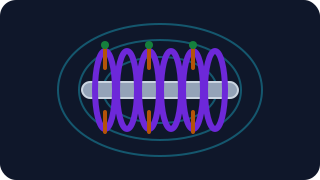
Electromagnet Workshop is a GCSE physics game about the electromagnet and the motor effect. On screen there is a coil of wire around a core. Two sliders set the number of turns and the current, and a menu changes the core to air, iron or steel. When you change them, the diagram draws more or fewer field lines around the coil.
The first questions are about strength. You choose the change that makes the electromagnet stronger from four options. After that, some questions ask about the poles. An arrow at the left end of the coil shows which way the current goes round, and you decide which end is north.
The last questions cover the motor effect, which is Higher tier. Some give you B, I and l, often in mT, mA or cm, and ask for the force on the wire. Others show a wire in a magnetic field with the current coming out of the page or going into it, and you use Fleming's left-hand rule to find which way the force acts.
There are ten questions in a round. A right answer is worth 10 points, with 5 extra for a quick one. The harder start skips the first level, so the motor effect arrives after three questions. If you choose a wrong option, the game explains the rule you needed.
The science behind electromagnets and the motor effect
A current in a wire makes a magnetic field around the wire. If you wind the wire into a coil, called a solenoid, the fields from all the turns add together. Inside the coil the field is strong and almost uniform, and outside it has a similar shape to the field of a bar magnet. An electromagnet is a solenoid with an iron core, and the core makes the field much stronger.
So you can make an electromagnet stronger with more turns, a bigger current or an iron core. Reversing the current leaves the strength the same and swaps the north and south poles.
To find the poles, look at one end of the coil and follow the current round. If it goes anticlockwise, that end is a north pole. If it goes clockwise, that end is a south pole. The right-hand grip rule gives the same result: curl the fingers of your right hand the way the current flows, and your thumb points to the north pole.
When a wire carrying a current is in a magnetic field, the wire and the magnet push on each other. This is the motor effect. For a wire at right angles to the field, F = B I l. F is the force in newtons, B is the magnetic flux density in tesla, I is the current in amps and l is the length of wire in the field in metres. With B = 50 mT, I = 2 A and l = 20 cm, F = 0.05 × 2 × 0.2 = 0.02 N. The page on the force on a conductor equation has more examples.
Fleming's left-hand rule gives the direction. Hold the thumb and first two fingers of your left hand at right angles to each other. Your first finger points along the field, your second finger points along the current, and your thumb gives the direction of the force.
Electromagnets are in AQA GCSE Physics (8463, section 4.7.2.1), Edexcel GCSE Physics (1PH0, 12.8 and 12.9) and OCR Gateway Physics A (J249, P4.1f and P4.1g). Fleming's left-hand rule and F = B I l are Higher tier only on all three: AQA 4.7.2.2, Edexcel 12.12 and 12.13, and OCR P4.2b and P4.2c. Each board prints F = B I l on the equation sheet in the exam, which you can compare on our physics equation sheet page. In the exam, the marks go on converting the units and using the correct hand.
Tips for electromagnet questions
- An option that only reverses the current can't be the answer to a question about strength.
- Look at the end with the arrow. Anticlockwise current means that end is north.
- Convert before you multiply: 50 mT is 0.05 T, 250 mA is 0.25 A and 20 cm is 0.2 m.
- F = B I l has no division in it. If you divided by the length, go back a step.
- In the direction questions, a dot means the current comes out of the page toward you, and a cross means it goes into the page.
Use your left hand for Fleming's rule. Your right hand gives the opposite direction, and that is one of the wrong options.
Use this in the classroom
Electromagnet Workshop suits Years 9 to 11. Every student can do the strength and pole questions, and the motor effect questions give Higher tier students calculation practice with prefixes.
Before a practical with coils and paper clips, let the class move the sliders and predict what the field lines will do. After the practical, a round of ten checks whether students can explain what they saw. For Fleming's left-hand rule, put a direction question on the board and ask everyone to hold up their left hand before they answer.
With practice mode on, there is no timer. The game runs in a web browser on school laptops and phones, and students do not make an account. There are more ideas on our page for teachers, and families can read about the site on the page for parents.
Similar games
Before magnetism, it helps to be sure about current. In Circuit Builder you predict the current and potential difference in series and parallel circuits. The all games page lists everything else.
Questions people ask
These questions about electromagnets and the motor effect come up again and again.
How do you make an electromagnet stronger for GCSE physics?
Add more turns to the coil, increase the current or put an iron core inside the coil. Reversing the current changes which end is north, and the strength stays the same.
How do you work out which end of an electromagnet is north?
Look at one end and follow the current. Anticlockwise means that end is north, and clockwise means it is south. You can also curl the fingers of your right hand the way the current goes, and your thumb points north.
Is F = B I l Higher tier only?
Yes, for AQA, Edexcel and OCR Gateway. Fleming's left-hand rule is Higher tier as well. Foundation students still learn about electromagnets and how to make them stronger.
Why is my answer for the force on a wire far too big?
A value probably still had its prefix. If you leave 50 mT as 50, the answer is 1,000 times too big, and leaving 20 cm as 20 makes it 100 times too big. Change mT to T, mA to A and cm to m before you multiply.