How to play Balance It
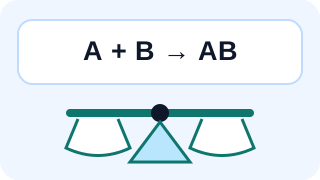
Balance It is a free GCSE chemistry game for practising balancing equations. Each question shows a symbol equation with every formula in place but no numbers in front of the formulas. Four versions of the equation appear below it, and you pick the one that is balanced.
A balanced equation has the same number of each type of atom on both sides of the arrow. The numbers you put in front of a formula are called coefficients. The small numbers inside a formula are called subscripts, and you must never change them. Each question has one option that breaks this rule, so look out for a formula that has changed.
Every reaction in the game is a neutralisation: an acid reacts with an alkali to make a salt and water. From question 8, the equations also carry state symbols, and one wrong option leaves a state symbol out. If you tick the harder start, state symbols arrive from question 4.
The clock gives you 15 seconds per question. A right answer scores 15 points, and a question counts as wrong if the clock reaches zero. Practice mode turns the clock off for a round of ten, and each right answer then scores 10. When you get one wrong, the game shows the balanced equation before you move on.
The science behind balancing equations
Atoms are not made or destroyed in a chemical reaction. They only swap partners to form new substances. So the total mass of the products equals the total mass of the reactants. This is the law of conservation of mass. A balanced equation shows it on paper: count the atoms of each element on the left, and you find the same number on the right.
In one of the game's reactions, sulfuric acid reacts with sodium hydroxide to make sodium sulfate and water. Unbalanced, it reads H₂SO₄ + NaOH → Na₂SO₄ + H₂O. The right side has two sodium atoms, so write a 2 in front of NaOH. The left side now has four hydrogen atoms, so write a 2 in front of H₂O. The result is H₂SO₄ + 2NaOH → Na₂SO₄ + 2H₂O. Check it: each side has 2 sodium, 1 sulfur, 6 oxygen and 4 hydrogen atoms.
A coefficient multiplies everything in the formula after it. A subscript after a bracket multiplies everything inside the bracket. So one Ca(OH)₂ holds one calcium atom, two oxygen atoms and two hydrogen atoms, and 2Ca(OH)₂ holds twice as many. If you change H₂O to H₂O₂ to fix a count, you have written hydrogen peroxide. That is a different substance, and it is not made in this reaction.
State symbols tell you the state of each substance: (s) for solid, (l) for liquid, (g) for gas and (aq) for aqueous. Aqueous means dissolved in water. In the game, the acid, the alkali and the salt are all (aq), and the water is (l).
Every GCSE board expects you to write balanced symbol equations with state symbols. AQA 8462 covers this in 4.3.1.1 and 4.2.2.2, and AQA 8464 in 5.3.1.1 and 5.2.2.2. Edexcel 1CH0 and 1SC0 cover it in point 0.3, and OCR Gateway J248 in C3.1. All three boards keep ionic equations for the Higher Tier, and this game does not ask for them.
Tips for balancing chemical equations
- Balance the metal first. Then balance groups such as sulfate, and leave hydrogen and oxygen until last.
- If a group like SO₄ or NO₃ appears unchanged on both sides, count it as one block. In calcium nitrate, Ca(NO₃)₂, there are two nitrate blocks.
- Compare every formula in an option with the formula in the question. If one has changed, rule that option out straight away.
- Nobody writes a 1 in front of a formula. No number means one.
- When state symbols appear, check that every formula has one.
Counting in your head is slow at first. Jot the atom totals for each side in two short columns, and the unbalanced options stand out.
Use Balance It in the classroom
Balance It suits Years 9 to 11 in lessons on conservation of mass, chemical equations or neutralisation. A round of ten takes about five minutes, so it works as a starter or a plenary.
Try this as a starter. Put one question on the board and ask pairs to count the atoms before anyone looks at the options. Then ask each pair to name what is wrong with each wrong option: a changed formula, a coefficient on one side only, or a missing state symbol.
Turn on practice mode for students who need more time. After a lesson on moles, Higher Tier groups can go on to Mole Ratio Rush, which uses the same acid and alkali reactions. The page for teachers explains how the games work in class, with no sign-up.
Similar games
To see which salt each acid makes, play pH Detective. To work out the mass of a formula like Na₂SO₄, try the formula mass questions in Periodic Table Challenge. Physics students balance nuclear equations in Half-Life, and the all games page has the rest.
Questions about balancing equations
Teachers and students often ask these questions about chemical equations.
How do you balance a chemical equation?
Count the atoms of each element on both sides of the arrow. Then add numbers in front of formulas until every element has the same count on each side. Never change the small numbers inside a formula, because that changes the substance.
Why do chemical equations have to be balanced?
Atoms are not made or destroyed in a reaction, so the mass of the products equals the mass of the reactants. A balanced equation shows the same atoms on both sides, which matches what really happens.
What do the state symbols (s), (l), (g) and (aq) mean?
They stand for solid, liquid, gas and aqueous. Aqueous means dissolved in water. Every GCSE board expects you to add them to a balanced equation when you are asked to.
Is balancing equations on the GCSE Foundation paper?
Yes. Balanced symbol equations with state symbols are Foundation content on AQA, Edexcel and OCR. Writing ionic equations is Higher Tier only on all three boards.