How to play Group Trends
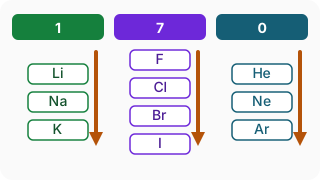
Group Trends is a free GCSE chemistry game about periodic table groups 1, 7 and 0. A group is a column of the table. The elements in one group have the same number of electrons in their outer shell, so they react in similar ways. Group 1 holds the alkali metals, group 7 the halogens and group 0 the noble gases. A round has ten questions in three steps.
The first three questions show the symbol of one element. You pick its group, or say how many electrons its outer shell holds. The next four give you a group, and you put its elements in order of reactivity or boiling point, lowest first. The last three add a halogen to a solution of halide ions. A halide is a compound of a halogen, such as potassium bromide. You decide if a reaction happens, and you pick the reason.
A 15 second bonus clock runs on every question. You get 10 points for a right answer and 5 more if you answer before the clock runs out. After that you can still answer for 10 points. Tick Harder start to skip the first step and begin with the trends. Practice mode turns the clock off. Tap or click an answer, then press Next. A short note after each answer explains the science.
The science behind periodic table groups
Atoms keep their electrons in shells around the nucleus, the tiny centre of the atom. The outer shell decides how an element reacts. Every group 1 atom has one electron there, and every group 7 atom has seven. The noble gases in group 0 have a full outer shell. That means eight electrons, or two for helium. A full shell is stable, so the noble gases are unreactive and exist as single atoms. Their boiling points rise as you go down the group. If shells are new to you, Inside the Atom shows how they fill.
The alkali metals are soft enough to cut with a knife. They react with water to give off hydrogen gas and leave an alkaline solution. Lithium fizzes steadily. Sodium melts into a ball and whizzes across the water, and potassium bursts into a lilac flame. So reactivity goes up down the group. Each metal reacts by losing its one outer electron. Lower down, the atom has more shells, so the outer electron sits further from the nucleus. The nucleus holds it less tightly, and the atom loses it more easily.
The halogens are non-metals. Their molecules are pairs of atoms, such as Cl2. At room temperature, chlorine is a pale yellow-green gas, bromine is a red-brown liquid and iodine is a dark grey solid. Their melting and boiling points go up down the group, because bigger molecules attract each other more strongly. A halogen reacts by gaining one electron to fill its outer shell. Lower down, that shell is further from the nucleus, so an incoming electron feels a weaker pull. The halogens get less reactive down the group, which is the opposite of group 1.
A more reactive halogen can take the place of a less reactive one in a solution of its salt. Chemists call this displacement. Add chlorine water to potassium bromide solution and the mixture turns yellow-orange, because bromine forms. The chlorine becomes chloride ions. Bromine added to potassium chloride does nothing, because bromine is the less reactive of the pair. Our periodic table page shows the table each exam board prints.
AQA covers this in Chemistry 8462 sections 4.1.2.4 to 4.1.2.6, and in Combined Science 8464 sections 5.1.2.4 to 5.1.2.6. Edexcel 1CH0 and 1SC0 cover it in topic 6. OCR J248 has it in C4.1a, C4.1b and C4.1d, and OCR J258 in C2.2 and C2.3. Edexcel names chlorine, bromine and iodine, and asks you to predict the other halogens from their pattern. The game adds fluorine to the trend questions.
Tips for periodic table groups questions
- For groups 1 and 7, the group number is the number of outer electrons. Group 0 breaks the rule, with 8, or 2 for helium.
- Group 1 gets more reactive as you go down. Group 7 gets less reactive. The two trends run in opposite directions.
- One cause explains both trends. Lower down, the outer shell is further from the nucleus. Metals lose an electron more easily, and halogens gain one less easily.
- In a displacement question, find the halogen that sits higher in group 7. If you add that one, the answer is yes.
- Read the reason as well as the yes or no. Two answers say no, but only one gives the right cause.
Use this periodic table groups game in the classroom
Group Trends suits Years 9 to 11 when you teach the periodic table. A round lasts about five minutes. Play it as a starter before you show the alkali metals in water, or at the end of the lesson.
Draw groups 1, 7 and 0 on the board as three columns. Before anyone plays, ask the class to add an arrow for each trend. Play the first step together. Then let pairs try the ordering step and write each trend as a sentence with its reason.
The displacement step fits the practical where students add halogen water to halide solutions in a spotting tile. Ask them to predict each result with the game first, then check it by the colour change.
Nobody needs an account to play. Our page on what we collect explains what the site keeps. For more lesson ideas, see the teachers page.
Similar games
Metals can displace each other too. Reactivity Rank has you order metals and predict those reactions. To find any element by its group and period, try Periodic Table Challenge. The chemistry games page lists the rest.
Questions about periodic table groups
Short answers to common questions about group 1, group 7 and group 0.
Why does reactivity increase down group 1 but decrease down group 7?
Both trends come from the outer shell moving further from the nucleus as you go down. A group 1 metal reacts by losing its outer electron, and a weaker pull makes that easier. A halogen reacts by gaining an electron, and a weaker pull makes that harder.
What happens when you add chlorine to potassium bromide solution?
Chlorine is more reactive than bromine, so it displaces it. The chlorine turns into chloride ions and bromine forms, so the solution turns yellow-orange. The word equation is chlorine + potassium bromide → potassium chloride + bromine.
Why are the noble gases unreactive?
Their atoms already have a full outer shell. Helium has 2 electrons in it, and the others have 8. A full shell is stable, so the atoms do not need to lose, gain or share electrons. That is why they exist as single atoms.
How do boiling points change down group 7 and group 0?
They rise down both groups. Fluorine and chlorine are gases at room temperature, bromine is a liquid and iodine is a solid. In group 0, the boiling point goes up from helium to neon to argon.