How to play Reflex Arc
Reflex Arc is a free GCSE biology game about the nervous system. A reflex arc is the path a nerve impulse takes when your body reacts without you thinking, like when you pull your hand off something hot. A round has ten questions in three steps, and each question has four answers.
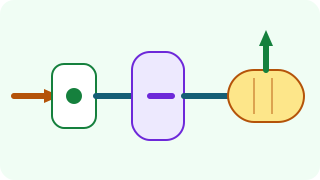
In the first three questions, you choose the right order for the parts of the arc. Four chains of parts appear, and three of them hold a mistake pupils often make. Next, for four questions, a drawing of the arc shows eight parts with the letters A to H. One letter has a dashed ring round it, and you name that part. The last three questions take you into real life. You find the receptor or the effector in a reflex, or you say why a reflex is so fast.
Each question has a bonus clock of 15 seconds. A right answer earns 10 points, or 15 if you beat the clock. You can still answer once the clock runs out, but you lose the extra 5 points. Tick Harder start to skip the order step and start with the drawing. Practice mode switches the clock off. On a keyboard, press 1 to 4 to pick an answer and Enter to go on. After each answer, the game tells you why the right one is right.
The science behind the reflex arc
Your nervous system lets you react to changes around you. A change that your body can detect is a stimulus. Receptors are cells that detect stimuli, such as light or heat. Neurones are nerve cells. They carry information from the receptors as electrical impulses to the central nervous system, or CNS. The CNS is your brain and your spinal cord. It decides what happens next and sends impulses out to effectors. An effector is a muscle that contracts or a gland that releases a hormone.
A reflex arc follows this order: stimulus, receptor, sensory neurone, relay neurone, motor neurone, effector, response. The sensory neurone carries the impulse from the receptor to the CNS. In a reflex such as the hot pan, the relay neurone sits inside the spinal cord and passes the impulse on. The motor neurone carries it out to the effector. Where two neurones meet there is a tiny gap called a synapse. A chemical crosses the gap and starts an impulse in the next neurone.
Reflexes are automatic and very fast. The conscious part of your brain, which you think with, is not involved. That speed protects you. Your hand leaves a hot pan before you have time to decide anything. The pupil reflex in the game works the same way. Its impulses pass through a part of the brain that works without you noticing, instead of the spinal cord.
Neurones are one kind of specialised cell. Each has a long thin part to carry impulses a long way. You can build an ordinary animal cell in Cell Builder and compare it.
AQA covers the nervous system and reflexes in Biology 8461 section 4.5.2.1 and in Combined Science 8464 section 4.5.2. Edexcel 1BI0 and 1SC0 cover neurones and synapses in 2.13 and the reflex arc in 2.14. OCR J247 covers them in B3.1a to B3.1c, and OCR J257 in B5.2.
Tips for reflex arc questions
- Learn the order as a sentence: the receptor senses, the sensory neurone sends, the relay neurone passes, the motor neurone moves.
- Sensory comes before motor. Sensory neurones bring impulses in to the CNS, and motor neurones take them out to the effector.
- The receptor detects and the effector responds. If an answer swaps the two, it is wrong.
- The spinal cord belongs to the CNS. It links the neurones, but it is never the receptor or the effector.
- In the drawing, the violet block is the spinal cord. The only neurone that sits fully inside it is the relay neurone.
- An answer that puts the brain in charge of a spinal reflex is a trap. Reflexes skip the conscious brain.
Use this reflex arc game in the classroom
Reflex Arc suits Years 9 to 11 when you teach the nervous system. A round of ten takes about five minutes, so it fits a starter or a check at the end of the lesson.
Put the drawing on the board and ask the class to name each letter before anyone plays. Then run a round together. In the order step, ask students which mistake each wrong chain makes. The swap of sensory and motor neurones comes up most.
The game links well with the reaction time practical, where one student drops a ruler and a partner catches it. Catching the ruler is a choice, so the conscious brain takes part. Ask the class why a reaction like this takes longer than a reflex. Then compare the path of each response.
Students need no account, and the clock turns off in practice mode for anyone who wants more time. Our privacy page lists what the site records, and the teachers page has more lesson ideas.
Similar games
The muscle that pulls your hand away needs blood to bring it oxygen and glucose. Heart and Circulation follows that blood round the body. Enzymes speed up the reactions inside your cells, and you can test them in Enzyme Activity. The biology games page has the rest.
Questions about the reflex arc
Here are short answers to the questions people ask most about reflexes.
What is the order of a reflex arc?
Stimulus, receptor, sensory neurone, relay neurone, motor neurone, effector, response. A synapse joins each neurone to the next one.
Why are reflex actions faster than other responses?
The impulse does not pass through the conscious part of the brain, so nobody has to decide what to do. The path is short and has few synapses, and the response is automatic.
What does a relay neurone do?
A relay neurone sits in the CNS. It takes the impulse from the sensory neurone and passes it on to the motor neurone. In many reflexes it is in the spinal cord.
Why are reflexes important?
They protect the body from harm. Your hand leaves a hot pan, and your pupils shrink in bright light, before you have time to think.