How to play Reactivity Rank
Reactivity Rank is a free GCSE chemistry game about the reactivity series, the list of metals in order of how readily they react. First choose your exam board: AQA, Edexcel or OCR Twenty First Century. Each board prints its own list, and the game only uses metals from the list you choose. A short note under the menu says what your board includes.
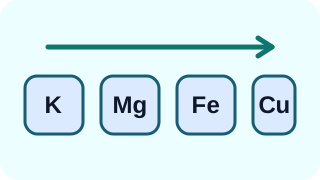
Each question shows a few metal tiles. You pick the list that puts them in order from most reactive to least reactive, with the sign > between them. The first three questions use three metals. After that, you rank four, and with the harder start every question has four.
From question 8, some questions become displacement duels. The game names two metals and asks whether the first will push the second out of one of its compounds. Each answer gives a yes or a no and a reason, and both parts must be right. Tick the harder start and the duels begin at question 4.
The timer allows 15 seconds per question. Answer correctly within the time for 15 points. A question left unanswered at zero counts as wrong. Practice mode has no timer, and each right answer is worth 10. A wrong answer brings up the right order or rule before the next question.
The science behind the reactivity series
When a metal reacts, its atoms lose electrons and form positive ions. The more easily a metal does this, the more reactive it is. You can put metals in order by watching how they react with water and with dilute acids. AQA sets this out in 4.4.1.2 of 8462, and Edexcel in point 4.3 of 1CH0.
The boards do not print the same list. This table shows each list as the board prints it, most reactive first.
| Board | Order in the specification |
|---|---|
| AQA | potassium, sodium, lithium, calcium, magnesium, zinc, iron, copper |
| Edexcel | potassium, sodium, calcium, magnesium, aluminium, (carbon), zinc, iron, (hydrogen), copper, silver, gold |
| OCR Twenty First Century | potassium, sodium, calcium, aluminium, magnesium, zinc, iron, lead, (hydrogen), copper, silver |
Carbon and hydrogen are not metals, but they are often placed in the series to compare with metals. Edexcel and OCR Twenty First Century both put carbon between aluminium and zinc. OCR uses carbon's place to explain how some metals are extracted from their ores. AQA says both non-metals are often included, without giving them a fixed slot.
In a displacement reaction, a more reactive metal takes the place of a less reactive metal in a compound. Zinc sits above copper on every list, so zinc can displace copper from a solution of a copper salt. Copper cannot displace zinc. Writing the ionic equation for a displacement is AQA Higher Tier content in 4.4.1.4, and the game does not ask for it.
OCR Gateway, J248, asks students to work out an order of reactivity from their own results in C4.1f. Its topic statements do not set out a fixed list, so the game leaves it out. At KS3, the national curriculum asks for the order of metals and carbon in the series without naming a set of metals.
Tips for the reactivity series
- Learn the list your own board prints. Potassium comes first on all three.
- AQA includes lithium, just below sodium. The AQA list has no aluminium, lead, silver or gold.
- Edexcel and OCR Twenty First Century list aluminium and magnesium in different orders. The game never asks you to order that pair, so you will not lose marks on it.
- Only OCR Twenty First Century includes lead, and only Edexcel includes gold.
- In a duel, find which of the two metals is higher on your list. If the first metal is higher, the answer is yes.
A made-up sentence can help you remember an order. Take the first letter of each metal on your board's list, and build a sentence from words that start with those letters. A sentence you wrote yourself is easier to recall than one you were given.
Use Reactivity Rank in the classroom
Reactivity Rank suits Years 9 to 11 in lessons on metals and their reactions. Set the board menu to the course your class takes before you start. A round of ten takes about five minutes.
It makes a good follow-up to a practical in which students add metals to water or dilute acid. They can put their own results in order first, then play a round to check against the specification list. Duel questions work as a quick check before a displacement practical: ask students to predict each result on mini whiteboards, then reveal.
For a Year 8 class learning the order of metals and carbon, play with the class in practice mode and talk through each order. The page for teachers has more on using the games with a class, and no one needs to sign up.
Similar games
Several of these metals give coloured flames, which you can name in Flame Test Lab. The most reactive metals sit in Groups 1 and 2, and you can place them in Periodic Table Challenge. Metals react with acids, and pH Detective covers acids and salts. For equation practice, try Balance It, or browse the all games page.
Reactivity series questions
These answers cover what students and teachers ask most about metal reactivity.
What is the order of the reactivity series for GCSE chemistry?
It depends on your board. AQA lists potassium, sodium, lithium, calcium, magnesium, zinc, iron and copper. Edexcel and OCR Twenty First Century use longer lists that add metals such as aluminium and silver.
Is the reactivity series the same for AQA, Edexcel and OCR?
No. AQA has eight metals and includes lithium. Edexcel adds aluminium, silver and gold. OCR Twenty First Century adds lead, and it lists aluminium and magnesium in a different order from Edexcel. OCR Gateway asks you to work out an order from experiments.
What is a displacement reaction in chemistry?
A reaction in which a more reactive metal takes the place of a less reactive metal in a compound. For example, zinc displaces copper from a copper salt solution. A less reactive metal cannot displace a more reactive one.
Where do carbon and hydrogen go in the reactivity series?
Edexcel puts carbon between aluminium and zinc and hydrogen between iron and copper. OCR Twenty First Century agrees on carbon and puts hydrogen between lead and copper. AQA gives them no fixed place.