How to play Rf Race
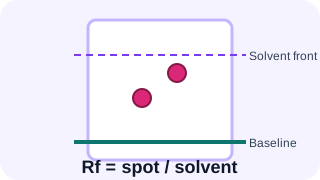
Rf Race is a free GCSE chemistry game about the chromatography Rf value. Each question shows a drawn chromatogram: a strip of paper with a baseline at the bottom, one or more coloured spots, and a dashed line near the top where the solvent stopped. The distances you need are printed above the drawing in millimetres.
In questions 1 to 3 there is one spot, A, and you pick its Rf value from four options. Questions 4 to 7 add a second spot, B, but still ask about spot A, so check you use the right distance. Questions 8 to 10 show the same sample run in two different solvents. You decide from the spots whether the sample is pure or a mixture. The harder start begins with two spots and brings the purity questions in from question 4.
There is a 15 second countdown on each question. Beat it with the right answer and you earn 15 points. Let it reach zero and the question is marked wrong. Practice mode removes the countdown, and each right answer then earns 10. A wrong answer opens the working, with the division laid out.
The science behind Rf values
Chromatography separates the substances in a mixture, such as the dyes in an ink. In paper chromatography, the paper stays still and a solvent soaks up through it. The paper is called the stationary phase and the moving solvent is the mobile phase. Each substance shares its time between the two. The more time it spends in the solvent, the further it travels before the solvent stops.
The Rf value compares how far a substance moved with how far the solvent moved. To find it, divide the distance the spot moved by the distance the solvent moved. Measure both distances from the baseline, the line where you put the sample at the start. For the substance, measure to the centre of the spot. For the solvent, measure to the solvent front, the highest point the solvent reached.
Say a spot moves 42 mm and the solvent front moves 70 mm. Rf = 42 ÷ 70 = 0.60. Both distances are in millimetres, so the units cancel and Rf has no unit. A substance can never move further than the solvent that carries it, so an Rf value always lies between 0 and 1.
Different substances usually have different Rf values, and the value for each one depends on the solvent. So you can compare an unknown spot with known substances in the same solvent to help identify it. A pure substance gives a single spot in every solvent. A mixture may separate into several spots, but two of its substances can travel the same distance in one solvent and look like one spot. That is why the game shows the sample in two solvents.
AQA covers Rf values in 4.8.1.3 of 8462 and 5.8.1.3 of 8464, and it is the only board that prints the Rf formula in its specification. Edexcel covers them in point 2.10c of 1CH0 and 1SC0. OCR includes them in C2.1i of Gateway, J248, and in C5.1 of Twenty First Century, J258. At KS3, chromatography is one of the named separation techniques, but calculating Rf values is GCSE content.
Tips for chromatography Rf questions
- Measure both distances from the baseline, never from the bottom edge of the paper.
- If your answer is bigger than 1, you have divided the wrong way round. Put the spot distance on top.
- Divide by the distance the solvent moved, not the length of the paper. The paper usually goes on past the solvent front.
- Measuring the spot down from the solvent front gives the wrong distance. One of the wrong options comes from this slip.
- Give the value to two decimal places, so 0.6 becomes 0.60.
For the purity questions, check both chromatograms before you choose. Two spots in either solvent means the sample is a mixture.
Use Rf Race in the classroom
Rf Race suits Years 9 to 11. It works well straight after students run their own paper chromatograms, for example of inks or food colourings. They can calculate Rf values from their own paper first, then play a round to check their method against the game.
Use the purity questions to start a discussion. Ask why one solvent is not always enough to prove a sample is pure, and let students find the answer in the two-solvent drawings. For a quick check at the end of a lesson, have students write each Rf calculation in full on mini whiteboards before they choose an option.
Younger students in Years 7 and 8 meet chromatography as a separation technique, so they can play the purity questions with support. Practice mode takes the timer away for anyone who needs longer. The page for teachers explains how to use the games with a class, with no accounts.
Similar games
Chromatography is one way to identify substances, and flame tests are another: try Flame Test Lab. For acids, alkalis and salts, play pH Detective. Higher Tier students who like working with ratios can move on to Mole Ratio Rush. You can also balance equations in Balance It or browse the all games page.
Chromatography questions
Answers to questions that often come up about chromatography and Rf values.
How do you calculate an Rf value in chromatography?
Divide the distance the substance moved by the distance the solvent moved. Measure both from the baseline, to the centre of the spot and to the solvent front. A spot at 42 mm with the solvent at 70 mm has an Rf of 0.60.
Why does an Rf value have no units?
Both distances are lengths in the same unit, such as millimetres. When you divide one by the other, the units cancel, so the Rf value is just a number.
How does chromatography show whether a substance is pure?
A pure substance gives one spot in every solvent you try. If any solvent separates the sample into two or more spots, it is a mixture.
Can an Rf value be greater than 1?
No. A substance cannot travel further than the solvent carrying it, so the Rf value is always between 0 and 1. An answer above 1 usually means the division is the wrong way round.