How to play Radiation Types
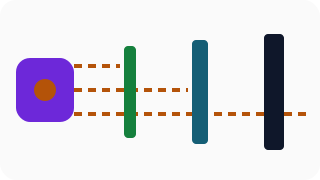
Radiation Types is a free GCSE physics game about nuclear radiation. Unstable nuclei give out four kinds: alpha, beta, gamma and neutron radiation. In each question, you read a clue and pick the radiation or the situation it describes. A round has ten questions in three steps.
The first three questions ask what each radiation is made of and what stops it. The next four give you a detector result or a real use, and you choose the radiation that fits. The last three take you into places where people work with radioactive sources. There you decide whether you see contamination or irradiation, or which safety statement is true.
Each question has a bonus clock of 20 seconds. A right answer earns 10 points, or 15 if you answer before the clock runs out. After that you can still answer, and you only lose the bonus. Tick Harder start to skip the first step. Practice mode hides the clock. Your best score for the harder start is kept on its own. After every answer, the game explains the right one.
The science behind nuclear radiation
Some atomic nuclei are unstable. To become more stable, they give out radiation and change. This is radioactive decay, and it happens at random. An alpha particle is two protons and two neutrons, the same as a helium nucleus. A beta particle is a fast electron. It forms inside the nucleus when a neutron changes into a proton. A gamma ray is electromagnetic radiation, from the same family of waves as light and X-rays. Some nuclei throw out a single neutron instead.
Alpha, beta and gamma radiation are ionising. They can knock electrons off atoms and turn them into ions, which are atoms with an electric charge. Alpha particles ionise the most. They lose their energy fast, so a sheet of paper or a few centimetres of air stops them. Beta particles ionise less. They get through paper, and a few millimetres of aluminium stops them. Gamma rays ionise the least, so they travel furthest. Thick lead or concrete absorbs most of them, though a little always gets through.
Each kind of decay changes the nucleus in its own way. Alpha decay lowers both its mass and its charge. Beta decay raises the charge and leaves the mass the same. Giving out a gamma ray changes neither. A neutron has no charge, so losing one lowers the mass number by 1 and leaves the charge alone. You can balance the equations for alpha and beta decay in Half-Life.
Contamination means radioactive atoms have got onto or into something, such as dust on a lab coat. Those atoms keep decaying, so the danger stays until someone removes them. Irradiation means an object is exposed to radiation from a source outside it. Alpha, beta and gamma radiation do not make the object radioactive. The source is still a hazard, so the people who use it stand behind shielding and keep their time near it short.
Gamma rays get out of the body, so doctors use them to look inside it. A patient takes in a tracer, which is a small amount of a radioactive substance, and a detector outside follows the gamma rays it gives out. Beams of gamma rays aimed from outside the body can kill cancer cells. Gamma rays also sterilise medical equipment and food. They pass through sealed packs and kill the germs inside.
This topic is in AQA 8463 sections 4.4.2.1, 4.4.2.2 and 4.4.2.4, with medical uses in 4.4.3.3. AQA Combined Science 8464 covers it in 6.4.2. Edexcel 1PH0 has it in 6.10 to 6.16, 6.20, 6.28 and 6.32, with gamma uses in 5.22. OCR J249 covers it in P6.1 and P6.2.
Tips for nuclear radiation questions
- Remember the order paper, aluminium, lead. Alpha stops first, then beta. Gamma goes furthest.
- A helium nucleus in the clue means alpha. A fast electron from the nucleus means beta.
- Gamma is an electromagnetic wave with no mass and no charge. Giving it out leaves the nucleus with the same numbers.
- When a count rate falls to background, the barrier has stopped the radiation. Background radiation is the low level around us all the time, from rocks and from space.
- Ask where the radioactive atoms are. If they sit on or inside the object, it is contaminated. If the radiation came from a source outside, the object is irradiated.
- Alpha, beta or gamma radiation from outside does not make an object radioactive, even after a long exposure.
Use this nuclear radiation game in the classroom
Radiation Types suits Years 9 to 11 when you teach atoms and nuclear radiation. A round of ten takes a few minutes, so it works as a starter or a recap at the end of a lesson.
Play the first step together before you show a Geiger-Müller tube, the detector that clicks each time radiation reaches it. Ask the class to predict what each barrier will do to the count rate. After the demonstration, set the second step. Its clues read like the results students have just seen.
The third step makes a good discussion starter. Many students think food turns radioactive once it has been irradiated. That idea appears as a wrong option in every contamination question. Ask students why it is wrong, then ask them to compare the hazards of the two situations.
For students who like more thinking time, switch the clock off with practice mode. Students need no account to play. See what the site records, or find more lesson ideas on the teachers page.
Similar games
Radiation starts in the nucleus, so it helps to know what a nucleus holds. Inside the Atom has you count protons and neutrons, and it ends with isotopes. Gamma rays sit at the far end of the electromagnetic spectrum, which you can sort in Wave Lab. The full list of games has more physics to try.
Questions about nuclear radiation
These are the questions teachers and students ask most about alpha, beta and gamma radiation.
What is the difference between alpha, beta and gamma radiation?
An alpha particle is two protons and two neutrons. A beta particle is a fast electron from the nucleus. A gamma ray is an electromagnetic wave. Alpha ionises the most and travels the shortest distance. Gamma ionises the least and travels furthest.
What stops alpha, beta and gamma radiation?
Paper or a few centimetres of air stops alpha particles. A few millimetres of aluminium stops beta particles. Thick lead or concrete absorbs most gamma rays, but a small amount always gets through.
What is the difference between contamination and irradiation?
Contamination is when radioactive atoms get onto or into something. They keep giving out radiation until someone removes them. Irradiation is when radiation from a source outside reaches an object. The object does not become radioactive.
Is contamination more dangerous than irradiation?
It often is. Irradiation stops once you move away from the source or put shielding in the way. Contaminating atoms stay with you and keep decaying. Inside the body, alpha particles do the most harm, because they give all their energy to the cells nearby.