How to play Fractional Distillation
Fractional Distillation is a free GCSE chemistry game about crude oil. Crude oil is a thick, dark mixture of many hydrocarbons. A hydrocarbon is a compound made of hydrogen and carbon atoms only. Fractional distillation splits crude oil into fractions. Each fraction is a group of molecules with a similar number of carbon atoms. A round has ten questions in three steps, and every question gives you four answers.
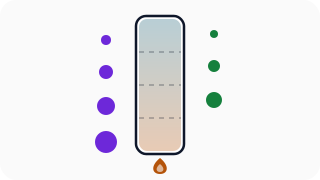
The first three questions show a drawing of the column. Two of them mark one end and ask which fraction comes out there. The other asks where a molecule of a given size leaves the column. The next four show four alkanes, and you pick the one that boils highest, flows most slowly or catches fire most easily. The last three are about the alkane formula. You write it from the number of carbon atoms, or count the carbon atoms in it.
Each question has a 15 second bonus clock. A right answer scores 10 points, plus 5 if you beat the clock. Once the clock reaches zero you can still answer for 10. Tick Harder start to skip the column and begin with the alkane comparisons. Practice mode turns the clock off. Keys 1 to 4 choose an answer, and Enter takes you on. After each answer, a short note tells you why the right answer is right.
The science behind fractional distillation
Crude oil formed from plankton, which are tiny living things in the sea. They died, and mud buried them long ago. It is a finite resource, so one day it will run out. Most of the hydrocarbons in it are alkanes. Every alkane fits the general formula CnH2n+2. If a molecule has n carbon atoms, it has 2n + 2 hydrogen atoms. So an alkane with 5 carbon atoms has 12 hydrogen atoms, and its formula is C5H12.
A refinery heats crude oil until most of it evaporates, which means it turns into a gas. The hot gas enters the bottom of a tall tower called a fractionating column. The column is hottest at the bottom and gets cooler towards the top. Each hydrocarbon condenses, or turns back into a liquid, once it cools below its boiling point. Big molecules have high boiling points, so they condense low down. Small molecules rise higher first. The smallest never condense in the column and leave the top as gases. If changes of state feel shaky, Solid, Liquid, Gas goes back over them.
Edexcel names six fractions. From the top of the column down, they are gases, petrol, kerosene, diesel oil, fuel oil and bitumen. The gases heat homes and cook food. Petrol fuels cars, and kerosene fuels planes. Diesel oil runs some cars and trains. Fuel oil powers large ships and some power stations. Bitumen is the thick, sticky part that covers roads and roofs. AQA names liquefied petroleum gases (LPG), petrol, kerosene, diesel oil and heavy fuel oil as fuels from crude oil. It does not ask for bitumen.
The size of a molecule changes how it behaves. As the chain of carbon atoms gets longer, the boiling point goes up. The liquid gets more viscous, which means thicker and slower to pour. It also gets less flammable, so it is harder to set alight. Edexcel calls this ease of ignition.
AQA covers this in Chemistry 8462 sections 4.7.1.1 to 4.7.1.3, and in Combined Science 8464 sections 5.7.1.1 to 5.7.1.3. Edexcel 1CH0 and 1SC0 cover it in 8.2 to 8.6. OCR J248 has it in C6.2j to C6.2l, and OCR J258 in C3.4. AQA and OCR give the formula CnH2n+2. Edexcel asks you to know that each homologous series, a family of similar compounds, shares one general formula.
Tips for crude oil questions
- Think hot at the bottom, cool at the top. Big molecules stay low, and small ones rise.
- Learn the Edexcel order from the top by use: cooker, car, plane, train, ship, road.
- In a comparison, find the biggest and the smallest molecule first. The answer is one of those two.
- To write an alkane formula, double the carbon number and add 2. Six carbon atoms gives C6H14.
- CnH2n is the formula for alkenes, which have a double bond. If the hydrogen count is not 2n + 2, it is not an alkane.
- To count carbon atoms, read the number after C. Do not use the hydrogen number, and do not add the two.
Use this fractional distillation game in the classroom
Fractional Distillation suits Years 9 to 11 when you teach crude oil and fuels. A round of ten takes about five minutes. Try it as a starter before you draw the column, or as a check at the end of the lesson.
Put a blank column on the board. Ask the class to mark the hot end and the cool end before anyone plays. Play the first step together and write in the fractions as they come up. Then let pairs play the comparison step and turn each trend into a full sentence.
The formula step fits a lesson where students build alkanes with molecular models. After they build a few, ask them to predict the formula for 7 or 8 carbon atoms, then check it in the game. If your class sits AQA, tell them that bitumen appears in the game but is not on their list.
Nobody signs in to play, and the page on what we collect sets out what the site stores. You can find more lesson ideas on the teachers page.
Similar games
Alkanes burn in oxygen to make carbon dioxide and water, and you can balance those equations in Balance It. Fractional distillation is one way to separate a mixture. Rf Race covers another, paper chromatography. The chemistry games page lists the rest.
Questions about fractional distillation
Short answers to the questions that come up most about crude oil and its fractions.
How does fractional distillation of crude oil work?
A refinery heats crude oil until most of it evaporates. The gas rises up a column that is hot at the bottom and cool at the top. Each hydrocarbon condenses at the height where the column is cool enough. Pipes draw off the liquids at different heights, and the smallest molecules leave the top as gases.
What are the fractions of crude oil and their uses?
From top to bottom, Edexcel lists gases for heating and cooking, petrol for cars and kerosene for planes. Next come diesel oil for some cars and trains, fuel oil for large ships and some power stations, and bitumen for roads and roofs. AQA names LPG, petrol, kerosene, diesel oil and heavy fuel oil, but not bitumen.
How do boiling point, viscosity and flammability change with chain length?
As the molecules get bigger, the boiling point rises. The liquid gets more viscous, so it flows more slowly. Bigger molecules are also less flammable, which means they are harder to light. Small molecules show the opposite of each trend.
What is the general formula of the alkanes?
It is CnH2n+2. An alkane with n carbon atoms has 2n + 2 hydrogen atoms. Methane is CH4, ethane is C2H6, propane is C3H8 and butane is C4H10.