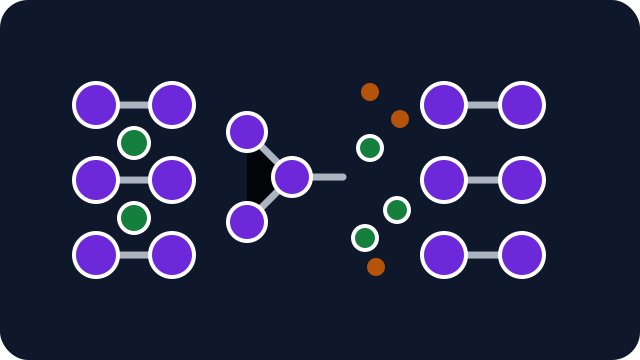
How to play Bonding Blitz
Bonding Blitz is a free GCSE chemistry game about ionic and covalent bonding, plus the metallic bonds that hold metals together. Each question shows one substance with its name and formula. You tap Ionic, Covalent or Metallic to say which type of bond holds it together.
After each answer, the game tells you why that bond is right. Read the reason even when you get it right, because the same three reasons come up again and again.
A round has ten questions in a random order: three ionic compounds, four covalent substances and three metals or alloys. Nitrogen can appear from question 4. From question 8, giant structures such as diamond and silicon dioxide can appear. Tick the harder start and nitrogen can turn up from the first question, with the giant structures from question 4.
You have 45 seconds for each question. A right answer scores 10 points and adds one to your streak. If the clock reaches zero, the question counts as wrong. On a keyboard, press 1, 2 or 3 to pick an answer and Enter to move on. Practice mode turns the clock off, so you can think each one through.
The science behind ionic, covalent and metallic bonds
There are three types of strong chemical bond: ionic, covalent and metallic. You can tell which one a substance has from the kinds of atoms in it. A metal joined to a non-metal gives ionic bonding. Non-metals on their own, or joined to each other, give covalent bonding. A metal on its own gives metallic bonding.
In ionic bonding, a metal atom passes electrons from its outer shell to a non-metal atom. The metal atom becomes a positive ion. An ion is an atom with an electrical charge. The non-metal atom gains electrons and becomes a negative ion. In sodium chloride, the ions pack into a giant lattice, which is a huge repeating pattern. Strong forces between the opposite charges act in every direction.
The ions made by metals in Groups 1 and 2, and by non-metals in Groups 6 and 7, end up with the same electron arrangement as a noble gas in Group 0. The charge on each ion follows from the group number. Group 1 metals form +1 ions and Group 2 metals form +2 ions. Group 6 non-metals form −2 ions and Group 7 non-metals form −1 ions. Sodium is in Group 1 and chlorine in Group 7, so sodium chloride is made of Na⁺ and Cl⁻ ions.
In covalent bonding, atoms share pairs of electrons, and each shared pair is a strong bond. Water, methane and ammonia are small molecules held together this way. Some covalent substances are giant structures instead. Diamond and silicon dioxide are both giant covalent structures.
In a metal, the atoms sit in a regular pattern. Their outer electrons are delocalised, which means they are free to move through the whole structure. The atoms share these electrons, and that sharing makes strong metallic bonds. Alloys, which are mixtures of metals, have metallic bonding too.
AQA 8462 covers this in 4.2.1.1 to 4.2.1.5, and AQA 8464 in the matching 5.2.1 section. Edexcel 1CH0 and 1SC0 cover it in points 1.21, 1.28 and 1.32. OCR Gateway J248 covers it in C2.2d and C2.2e.
Tips for spotting the type of bonding
- Read the formula before the name. Split it into its elements and ask which ones are metals.
- One metal plus one non-metal means ionic. Sodium chloride is the one to learn first.
- Only non-metals means covalent, even when the formula has two different elements, as in HCl or CO₂.
- Only metal atoms, one metal or an alloy, means metallic.
- Diamond is pure carbon, and carbon is a non-metal. So diamond is covalent, even though it forms a giant structure.
A common mistake is to think sodium chloride is made of Na⁺ Cl⁻ molecules. It has no molecules at all, only a lattice of ions. If you are not sure which elements are metals, practise with the Periodic Table Challenge first.
Use Bonding Blitz in the classroom
Bonding Blitz fits Years 9 to 11, straight after you teach the three types of bond. A round takes about five minutes, so it works as a lesson starter or as a check before you move on to dot and cross diagrams.
One way to run it: play a round on the board as a class, with pupils calling out the answer before anyone taps. Stop after each covalent molecule and ask a pupil to sketch its dot and cross diagram on a mini whiteboard. By the end of the round, the class has drawn many of the molecules AQA lists.
For homework, set the harder start and ask pupils to note their score. It reaches diamond and silicon dioxide sooner, which leads into a lesson on giant structures. The page for teachers explains how the games work in class, with no accounts to set up.
Similar games
For more on chemical reactions, Rates of Reaction Graphs asks you to read the rate from a curve. All our chemistry games are on the chemistry games page. The GCSE games page mixes physics and biology in too, and every game on the site is listed in one place.
Questions about ionic and covalent bonding
These are common questions about the three types of bond.
How can you tell if a substance has ionic, covalent or metallic bonding?
Look at the elements in it. A metal joined to a non-metal is ionic. Non-metals only is covalent. A metal on its own, or an alloy, is metallic.
Is diamond ionic or covalent?
Diamond is covalent. It is made only of carbon, a non-metal. Its atoms form a giant covalent structure, like silicon dioxide.
Why is sodium chloride not made of molecules?
Sodium chloride is a giant lattice of positive sodium ions and negative chloride ions. Strong forces act between the ions in every direction, so there are no separate molecules.
Which dot and cross diagrams do GCSE students need to draw?
AQA names eight molecules: hydrogen, chlorine, oxygen, nitrogen, hydrogen chloride, water, ammonia and methane. Edexcel lists hydrogen, hydrogen chloride, water, methane, oxygen and carbon dioxide. OCR asks for simple covalent substances and ionic compounds made of two elements. All of these molecules appear in Bonding Blitz.