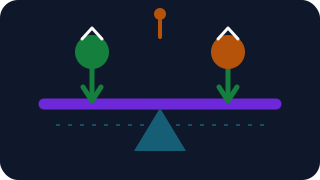
How to play Moments Balance
Moments Balance is a GCSE physics game about the principle of moments. Each question shows a beam resting on a pivot. The loads on the left are marked with their size and their distance from the pivot. On the right is one missing value, shown with a question mark. The drawing gives the size of each load above it and its distance from the pivot below the beam.
Every question has two steps. First you pick the force or the distance that makes the beam balance. Then you pick the total moment of the loads on the left, in newton metres. Each step has four options.
In the first three questions, the beam has one force on each side, and the distances are in whole metres. The next four put two forces on the left, give distances in centimetres, and ask for the missing distance. The last three use masses in kilograms, so you turn each mass into a weight with W = m g first. The game shows g = 9.8 N/kg on screen. Tick the harder start to begin with the centimetre questions.
Each right step scores 10 points, plus 5 if you answer within 15 seconds. When the clock reaches zero you can still answer, without the bonus. The practice switch turns the timer off. After a wrong step, the game shows the full working for the question.
The science behind the principle of moments
A force can make an object turn about a pivot. The turning effect is the moment of the force. Its size is moment = force × distance, or M = F d. The distance is the perpendicular distance from the pivot to the line of action of the force. With the force in newtons and the distance in metres, the moment is in newton metres (N m).
The principle of moments says that when an object is balanced, the total clockwise moment about the pivot equals the total anticlockwise moment. On the beam in the game, the loads on the left turn it anticlockwise and the load on the right turns it clockwise. The beam balances when the two totals are equal.
The same idea explains how a lever works. A small force far from the pivot can balance a large force close to it. That is why a long spanner turns a tight nut more easily than a short one.
Take a 12 N force 3 m from the pivot. Its moment is 12 N × 3 m = 36 N m. To balance it with a force 4 m from the pivot on the other side, you need 36 N m ÷ 4 m = 9 N.
With two loads on one side, work out each moment and add them. A distance in centimetres has to become metres before the moment is in N m, so 40 cm is 0.4 m. A missing distance can stay in centimetres, as long as every distance in the sum uses the same unit. If the loads are masses, change each one into a weight first. A 2 kg mass has a weight of 2 kg × 9.8 N/kg = 19.6 N.
AQA 8463 covers moments in 4.5.4, which it marks as physics only. Edexcel 1PH0 has them in 9.7P and 9.8P, and OCR J249 in P2.3l. OCR J259 includes the moment equation in P4.3. You can see how each board prints the equations on the moment equation page and the weight equation page.
Tips for moments questions
- A moment is force times distance. Dividing the force by the distance gives a wrong answer that can look believable.
- Work out each load's moment on its own, then add them. If you add the distances first, the total comes out wrong.
- Change centimetres to metres before you give a moment in N m. If you forget, your answer is 100 times too big.
- Masses are in kilograms. Multiply each one by 9.8 to get its weight in newtons before you use M = F d.
- Check your answer: work out the moment on each side of the pivot. The two totals should match.
Take step 1 slowly. The total moment you work out there is the answer to step 2, once it is in N m.
Use this in the classroom
Moments Balance suits Years 9 to 11 studying GCSE Physics. A round has ten beams and twenty steps, and takes about ten minutes.
Try it after a practical with a metre rule balanced on a pivot and slotted masses. Students find the balance point on the bench, then use the game to practise the same calculation with other values.
The two steps suit whole-class questioning. Stop after step 1 and ask the class how they know the beam balances before anyone picks the moment. A student who added the distances, or used a mass as a force, will usually spot the slip once they say their working aloud. The practice switch removes the timer for students who need it.
Students need no login. The page for teachers has more ideas for lessons, and parents can read about the site on the page for parents.
Similar games
To practise the forces that act on an object, play Resultant Force. For the same equations in other questions, try Equation Rearranger. The all games page lists every game on the site.
Questions people ask
Students and teachers often ask these questions about moments.
What is the principle of moments?
When an object is balanced, the total clockwise moment about a pivot equals the total anticlockwise moment about the same pivot.
How do you calculate a moment in physics?
Multiply the force in newtons by the perpendicular distance from the pivot in metres. The answer is in newton metres, N m.
How do you find the missing force to balance a beam?
Add up the moments on the side you know. Then divide that total by the distance of the missing force from the pivot.
Why do I need to multiply the mass by 9.8?
A moment uses a force, and mass is not a force. Weight is a force, and W = m g. In this game g is 9.8 N/kg, so a 3 kg mass has a weight of 29.4 N.