How to play Cell Builder
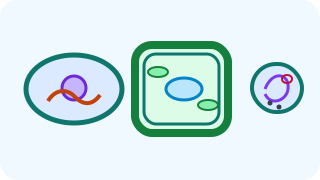
Cell Builder is a free GCSE biology game about animal and plant cells, and about bacterial cells too. Each round shows an empty cell outline. A tray below holds the parts. Pick one, then tap the cell, and the part drops into its place. On a computer you can also drag a part onto the cell.
The tray always holds a few parts that do not belong. An animal cell round offers a cell wall, chloroplasts and a permanent vacuole. A plant cell round offers a DNA loop and plasmids, and a bacterial cell round offers a nucleus, mitochondria and chloroplasts. If you try a part in the wrong place, the game tells you and your streak drops to zero. The round ends when every part is in place.
A game has ten rounds. The first three are animal cells and the next four are plant cells. Round eight is a bacterial cell. In round nine you see an empty outline and say which kind of cell it is, and in round ten you match a part to its job. Tick the harder start to begin with plant cells and meet more mixed rounds at the end.
Each finished build scores 10 points, and so does each right answer to a naming or job question. A 45-second clock counts down on each round. If it reaches zero first, the round counts as wrong and scores nothing. The practice switch turns the clock off. Your best score is saved on this device, with a separate best for the harder start.
The science behind animal and plant cells
Animal and plant cells are eukaryotic cells. That means their genetic material sits inside a nucleus. Bacterial cells are prokaryotic. They are much smaller, and their genetic material is not inside a nucleus. It is a single loop of DNA. Many bacteria also have plasmids, small rings of DNA in the cytoplasm. AQA says there may be one or more.
In AQA's list, an animal cell has a nucleus, cytoplasm, a cell membrane, mitochondria and ribosomes. A plant cell has all of these as well as chloroplasts and a permanent vacuole filled with cell sap. Plant cells also have a cell wall made of cellulose. The animal and plant rounds use these lists.
OCR's Gateway course (J247) links each part to its job. The nucleus holds the genetic material. Mitochondria contain the enzymes for respiration, and chloroplasts contain chlorophyll. The cell membrane has receptor molecules and acts as a barrier that lets some molecules through but not others. Ribosomes are where the cell makes proteins. The function round in the game uses these jobs.
AQA 8461 and 8464 cover cells in 4.1.1.1 and 4.1.1.2. Edexcel 1BI0 and 1SC0 cover them in 1.1, and their list for bacteria is a little different, including flagella, which this game leaves out. OCR J247 has cell structures in B1.1. OCR J257 spreads the topic out, with the nucleus and plasmids in B1.1 and ribosomes and the membrane in other topics. KS3 science covers the cell wall, cell membrane, cytoplasm, nucleus, vacuole, mitochondria and chloroplasts.
Tips for animal and plant cell diagrams
- Start with the parts that every cell in the game has: cytoplasm, a cell membrane and ribosomes.
- Only plant cells have chloroplasts and a permanent vacuole. Plant cells and bacteria both have a cell wall, but animal cells do not. Leave all three in the tray for an animal cell.
- A bacterium has no nucleus and no mitochondria. Its DNA goes in as a loop, with plasmids beside it.
- In the naming round, look inside the cell first. Chloroplasts mean a plant cell. No nucleus, with a loop of DNA, means a bacterium.
- Mitochondria and chloroplasts are easy to swap. Mitochondria are for respiration, and chloroplasts hold chlorophyll.
A wrong part resets your streak, and so does running out of time. A steady build that finishes inside the 45 seconds keeps it growing.
Use this in the classroom
Cell Builder suits Years 9 to 11 at the start of the cell biology topic, or as revision before a test. A game of ten rounds takes about five minutes.
Put the empty animal cell on the board and ask the class to name the five parts before anyone taps. Then move to a plant cell and ask which three parts are new. If a student tries a cell wall on an animal cell, ask them to explain why the game turns it down. The naming round makes a good last question for the lesson. Show a plant cell outline and ask for two reasons it cannot be an animal cell.
Year 7 and 8 classes meet most of these parts in KS3 science, so the animal and plant rounds work for them as well. Ribosomes and bacterial cells are not on the KS3 list, so tell younger students they will meet a few new parts.
The practice switch turns the clock off for anyone who wants more time. Nobody needs an account to play. Our page for teachers has more lesson ideas, and the what we collect page explains what the site records.
Similar games
Once you know where the mitochondria sit, find out what happens inside them in Respiration Equations. Photosynthesis Lab turns to the chloroplasts, and Magnification Challenge works out how big a cell really is under a microscope. The all games page lists the rest.
Questions people ask
These are the questions students and teachers often ask about cells.
What is the difference between animal and plant cells?
Plant cells have three parts that animal cells do not: a cellulose cell wall, chloroplasts and a permanent vacuole filled with cell sap. Both kinds have a nucleus, cytoplasm, a cell membrane, mitochondria and ribosomes.
Do bacterial cells have a nucleus?
No. The genetic material in a bacterial cell is a single loop of DNA that is not inside a nucleus. Bacteria can also have plasmids. Animal and plant cells keep their genetic material in a nucleus.
What do mitochondria and chloroplasts do?
Mitochondria contain the enzymes for respiration, the reaction that releases energy in a cell. Chloroplasts contain chlorophyll, and they are where photosynthesis happens in a plant cell.
Which cell parts are on the GCSE biology specification?
It depends on your board. AQA lists the nucleus, cytoplasm, cell membrane, mitochondria and ribosomes for animal cells. It adds a cell wall, chloroplasts and a permanent vacuole for plant cells. Edexcel's list for bacteria includes flagella, which this game does not show.