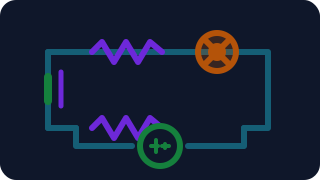
How to play Circuit Builder
Circuit Builder is a game about series and parallel circuits. A round has ten circuits. For each one you build the circuit, then predict what one of the meters will read.
The parts wait in a tray under the board: a cell, a switch, a bulb, one or more resistors, an ammeter and a voltmeter. A faint outline on the board shows where each one goes. Tap a part and then its space, or drag it across. When every part is in place, the game asks what the marked meter reads, and you pick from four answers.
Once you answer, the bulb lights up. Its brightness depends on the power the bulb transfers. The game then shows the current, the potential difference, the bulb's power and the circuit rules behind them.
The first three circuits are in series. Circuits 4 to 7 have two resistors in parallel, and the last three mix series and parallel parts. A right answer scores 10 points, plus 5 more if you answer within 15 seconds. The harder start begins with parallel circuits and moves to the mixed ones after three. Practice mode turns the timer off.
The science behind series and parallel circuits
In a series circuit the parts sit one after another in a single loop. The same current flows through every part, and the parts share the potential difference of the cell. The total resistance is the sum of the resistances, so a 10 Ω bulb and a 20 Ω resistor give 30 Ω.
To find the current, use V = I R with the total resistance, rearranged as I = V ÷ R. A 6 V cell across 30 Ω gives 0.2 A. A voltmeter across the 20 Ω resistor then reads 0.2 A × 20 Ω = 4 V, and the other 2 V is across the bulb.
In a parallel circuit the current splits at a junction. Each branch has the same potential difference across it, and the branch currents add up to the current in the main wire. An ammeter in the main wire reads that total. A new branch gives the charge another path, so the total resistance goes down. Two resistors in parallel always have less resistance than the smaller one on its own.
In the parallel and mixed circuits here, a bulb sits in series with the parallel section. The bulb and the parallel section share the cell's potential difference, so a voltmeter across the branches reads less than the cell.
All three exam boards teach these rules. AQA (8463) covers them in section 4.2.2, series and parallel circuits, and says students do not need to calculate the total resistance of two resistors in parallel. Edexcel (1PH0) asks students to explain why resistors in series raise the total resistance and resistors in parallel lower it (point 10.14). OCR Gateway (J249) covers the same ideas in P3.2, and OCR Twenty First Century (J259) in P3.3. In the game's working, the parallel section is only compared with its smallest branch.
Tips for series and parallel circuit questions
- In a series circuit the current is the same all the way round, so rule out any answer that splits it between the parts.
- Across a parallel section, every branch has the same potential difference. Adding the branch voltages together gives a number that is too big.
- The ammeter in the main wire reads the total current, which is more than the current in any one branch.
- No voltmeter in these circuits can read more than the cell. Use the cell's potential difference as a ceiling.
- Current is V ÷ R. If you multiplied V by R, your answer will be far too big.
After each answer, look at the bulb. A dim glow means only a small current is flowing through it, which helps you check the numbers in the working.
Use Circuit Builder in the classroom
Circuit Builder suits Years 9 to 11 and follows on well from a practical lesson with real circuits. A round of ten takes around ten minutes, because students place every part before they predict.
Use the first three circuits as a starter on series rules. Before students answer, ask them what would happen to the ammeter reading if you added another resistor. After the bulb lights, read the rules in the working aloud together.
For a plenary after a lesson on parallel circuits, tick the harder start and play on the board. Every wrong option comes from a real mistake, such as adding the branch voltages or taking one branch current as the total. Ask the class to name the mistake behind each one.
Practice mode switches off the 15-second bonus timer for students who want more time. The game needs no login and works on tablets and Chromebooks. Read the page for teachers for more ideas, and see what data the site collects before you use it with a class.
Similar games
See the full games list for more physics practice. Unit Sprint drills the prefixes you meet in circuit questions, such as mA and μA. Equation Rearranger gives practice with electrical equations such as P = I V.
Questions people ask
Students and teachers often ask these questions about series and parallel circuits.
What is the difference between series and parallel circuits?
In a series circuit every part is in one loop, so the current is the same everywhere and the parts share the potential difference. In a parallel circuit the current splits into branches. Each branch has the same potential difference, and the branch currents add up to the total.
Why does adding a resistor in parallel lower the total resistance?
The new branch gives the charge another path. More charge can flow for the same potential difference, so the total current goes up and the total resistance goes down.
Do I have to calculate resistors in parallel for GCSE physics?
AQA says students do not need to calculate the total resistance of two resistors in parallel. You do need to know that it is less than the smallest resistor. Check your own board's specification for its exact wording.
Which year groups is Circuit Builder for?
It suits Years 9 to 11. Year 9 students can start with the series circuits. Year 10 and 11 students can use the harder start to go straight to parallel and mixed circuits.