How to play Inside the Atom
Inside the Atom is a free GCSE chemistry game about atomic structure. Atomic structure means what an atom is made of: protons, neutrons and electrons. Each question shows an atom or an ion. You count one kind of particle, or you pick the right pattern, from four answers.
Questions 1 to 4 show an atomic symbol with two numbers. The small number at the bottom is the atomic number, and the one at the top is the mass number. Questions 5 to 7 give an atomic number from 3 to 20 and ask for the electronic structure, such as 2,8,1. Questions 8 to 10 are about ions, and question 9 asks you to spot a pair of isotopes. The harder start skips the symbols and brings in ions from question 4, with isotope questions at 6 and 9.
Each right answer is worth 10 points, with a 5 point bonus if you answer inside 15 seconds. When the bonus time runs out, the question stays open. Switch on practice mode to hide the clock. The worked answer shows the sum behind every question.
The science behind atomic structure
Every atom has a tiny nucleus at its centre. The nucleus holds the protons and neutrons, and the electrons sit around it in shells. Almost all of the mass of an atom is in the nucleus. An atom has a radius of about 0.1 nanometres, and the radius of its nucleus is less than one ten-thousandth of that.
The atomic number is the number of protons. Every atom of an element has the same number of protons, and atoms of different elements have different numbers. In an atom, the number of electrons equals the number of protons, so the atom has no overall charge. The mass number is the number of protons plus the number of neutrons. To find the neutrons, take the atomic number away from the mass number. An atom with atomic number 6 and mass number 12 has 6 protons, 6 neutrons and 6 electrons.
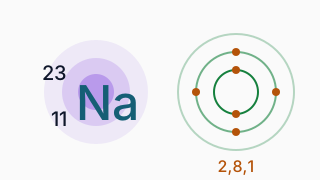
Electrons fill the lowest energy levels first. Energy levels are also called shells, and your exam can use either word. Sodium has 11 electrons: two in the first shell, eight in the second and one in the third. You write this as 2,8,1. Argon is a noble gas with eight electrons in its outer shell, so it is 2,8,8. Potassium, element 19, is in Group 1 and has one outer electron, which makes it 2,8,8,1.
An ion is an atom that has lost or gained electrons, so it carries a charge. The nucleus does not change, so the number of protons stays the same. A positive ion has lost electrons, and a negative ion has gained them. Lithium forms Li⁺, with 3 protons and 2 electrons. Oxygen forms O²⁻, with 8 protons and 10 electrons.
Isotopes are atoms of the same element with different numbers of neutrons. They share an atomic number but have different mass numbers. The relative atomic mass of an element is an average that takes account of how common each isotope is.
You meet this topic in AQA 8462 section 4.1.1 and AQA 8464 section 5.1.1. Edexcel 1CH0 and 1SC0 cover it in points 1.2 to 1.10, 1.19 and 1.23. OCR Gateway J248 covers it in C1.2.
Tips for atomic structure questions
- In an atom, the bottom number gives you both the protons and the electrons. Only the neutron question needs the top number.
- The top number counts protons and neutrons together, so it is never smaller than the bottom one.
- Add up an electronic structure before you pick it. The total must equal the atomic number.
- Fill each shell before you start the next one. A pattern such as 2,7,2 breaks that rule.
- For a positive ion, take the charge away from the protons to get the electrons. For a negative ion, add it on.
- Isotopes share the bottom number. If the bottom numbers differ, the two atoms belong to different elements.
AQA writes electronic structures with commas, as 2,8,1. Edexcel uses dots, as 2.8.1. Both mean the same thing.
Use Inside the Atom in the classroom
Inside the Atom fits Years 9 to 11 when a class first meets atomic structure at GCSE. A round of ten takes about five minutes, so it makes a quick starter.
Try it with mini whiteboards. Show one atomic symbol and ask everyone to write the protons, neutrons and electrons before you reveal the options. Each wrong option comes from a real slip, such as reading the mass number as the proton count. So the wrong answers students pick show you what to teach again.
Later in the topic, use the harder start as a plenary on ions. Pair it with our ionic bonding guide, which shows how metal and non-metal atoms lose or gain electrons. Students who want every element's numbers in one place can open the AQA GCSE periodic table.
Similar games
Groups and outer electrons come up again in Periodic Table Challenge. To see ions at work, play Electrolysis Products, where they move to the electrodes. Physics students can explore unstable nuclei in Half-Life.
Questions about atomic structure
Short answers to common questions about atoms.
How do you work out the number of neutrons in an atom?
Take the atomic number away from the mass number. The mass number counts protons and neutrons, and the atomic number counts protons only. So an atom with mass number 23 and atomic number 11 has 12 neutrons.
What is the difference between atomic number and mass number?
The atomic number is the number of protons in an atom. The mass number is the number of protons plus neutrons. On an atomic symbol, the mass number sits at the top and the atomic number sits at the bottom.
How do you write the electronic structure of an element?
Use the atomic number to find how many electrons the atom has. Fill the lowest shells first: up to two electrons in the first shell, then up to eight in the second. Chlorine has 17 electrons, so its structure is 2,8,7.
What are isotopes?
Isotopes are atoms of one element with different numbers of neutrons. They have the same number of protons, so they are the same element, but their mass numbers differ. Every element's atomic number is on our periodic table.