How to play Energy Changes
Energy Changes is a free GCSE chemistry game about exothermic and endothermic reactions. Every chemical reaction moves energy between the chemicals and their surroundings. The surroundings are everything around the reaction, such as the water in a beaker or your hand. A round has ten questions in three steps.
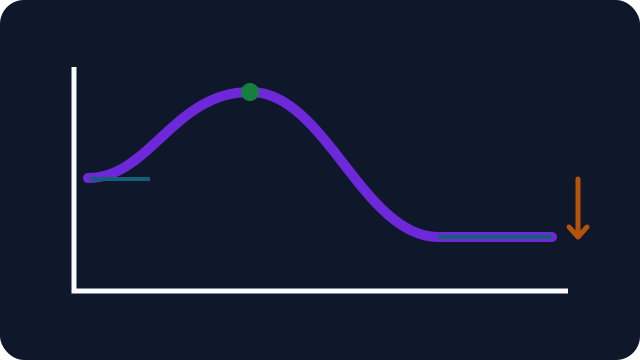
The first three questions describe a reaction, such as a fuel that burns or a cold pack you squeeze. You say which type it is and what happens to the temperature. The next four show a reaction profile, which is a graph of energy as the reaction goes on. You name the type, read off the activation energy or the overall energy change, or pick the way the arrow points. The last three give you bond energies, and you work out the overall change.
There is a 15 second bonus clock on each question. A right answer is worth 10 points, and you earn 5 more if you beat the clock. Once it hits zero, a right answer still earns 10. Tick Harder start to skip the first step and get three profile questions, then seven on bond energies. Practice mode switches the clock off. Keys 1 to 4 pick an answer, Enter moves you on, and the working appears after each answer.
The science behind exothermic and endothermic reactions
A reaction never makes or destroys energy. It moves energy from one place to another. In an exothermic reaction, energy moves from the chemicals to the surroundings, so the temperature around them goes up. The products end up with less energy than the reactants had. Burning a fuel is exothermic. So is neutralisation, where an acid and an alkali cancel each other out, and so are many oxidation reactions. Hand warmers and self-heating cans rely on this.
An endothermic reaction takes energy in from the surroundings, so the temperature around it drops. Thermal decomposition is endothermic. That means using heat to break one compound into simpler ones, as when calcium carbonate splits into calcium oxide and carbon dioxide. The reaction between citric acid and sodium hydrogencarbonate is endothermic too. Some sports injury packs use a reaction like this to feel cold.
Particles only react when they hit each other with enough energy. The least energy they need is the activation energy. A reaction profile shows it as a hump. The curve climbs from the reactants on the left to a peak, then falls to the products on the right. The height from the reactants to the peak is the activation energy. The gap from the reactants to the products is the overall energy change. Rates of Reaction Graphs shows how these collisions set the speed of a reaction.
When substances react, some bonds break and new ones form. A bond is the link that holds two atoms together. Breaking a bond takes energy in, and making a bond gives energy out. Each type of bond has a bond energy in kilojoules per mole (kJ/mol). A mole is a fixed, very large number of particles. To find the overall change, add up the energy needed to break every bond in the reactants. Then take away the energy given out by every bond made in the products. A minus answer means more energy came out than went in, so the reaction is exothermic. If bonds are new to you, start with Bonding Blitz.
AQA covers this in Chemistry 8462 sections 4.5.1.1 to 4.5.1.3, and in Combined Science 8464 sections 5.5.1.1 to 5.5.1.3. Edexcel 1CH0 and 1SC0 cover it in 7.10 to 7.16. OCR J248 has it in C3.2a to C3.2d, and OCR J258 in C1.2. All three boards test the bond energy sums on the Higher tier only, and the game labels those questions. On AQA, the idea of bonds breaking and forming is Higher tier too. Edexcel asks every student to know that breaking bonds takes energy in and making bonds gives it out.
Tips for energy change questions
- Watch the thermometer in the mixture. If the reading goes up, the reaction is exothermic.
- Thermal decomposition needs you to keep heating, because it takes energy in. It is endothermic.
- Activation energy runs from the reactants up to the peak. Do not measure it from the products.
- For the overall change on a profile, do products minus reactants and keep the sign. A minus answer is exothermic.
- In a bond question, multiply each bond energy by how many of that bond there are. Then do break minus make, never make minus break.
- Give your answer in kJ/mol, the same unit as the bond energies.
Use this energy changes game in the classroom
Energy Changes suits Years 9 to 11 when you teach energy in reactions. A round of ten takes about five minutes. Use it as a starter before the practical on temperature changes, or as a quick check at the end.
Before the practical, play the first step as a class and ask students to predict if each mixture will warm up or cool down. After they measure the temperature changes, they compare the results with their guesses. This fits the AQA required practical on temperature changes in reacting solutions.
For the profile step, draw an empty energy axis on the board. Pairs sketch one exothermic and one endothermic profile, then play and check their labels. Higher tier groups can tick Harder start to spend most of the round on bond energies. Tell Foundation groups that the last three questions are Higher tier only.
No one needs an account to play, and our page on what we collect shows what the site keeps. The teachers page has more lesson ideas.
Similar games
How far the temperature rises also depends on what you heat. Heat It Up works through that with specific heat capacity. Combustion equations need balancing, and Balance It gives you practice. The chemistry games page lists the rest.
Questions about exothermic and endothermic reactions
Quick answers about energy changes.
What is the difference between exothermic and endothermic reactions?
An exothermic reaction gives energy out to the surroundings, so the temperature goes up. Burning and neutralisation are two examples. An endothermic reaction takes energy in, so the temperature goes down, as in thermal decomposition.
What is activation energy?
It is the least energy that particles need to react when they collide. On a reaction profile, it is the height from the reactants up to the peak of the curve. Even an exothermic reaction such as burning needs this energy to start.
How do you calculate the energy change from bond energies?
Add up the energy needed to break all the bonds in the reactants. Then add up the energy given out when all the bonds in the products form. Take the second total away from the first. If breaking needs 2,000 kJ/mol and making gives out 2,300 kJ/mol, the change is −300 kJ/mol. The minus sign tells you the reaction is exothermic.
Are bond energy calculations on the Foundation tier?
No. AQA, Edexcel and OCR test bond energy sums on the Higher tier only. Foundation students on every board still sort reactions by temperature change and work with reaction profiles.