How to play Natural Selection
Natural Selection is a free GCSE biology game about how inherited differences can change a population over generations. Play ten questions across three levels. First, sort examples of genetic and environmental variation and match key terms. Then put natural selection in order and follow a moth or bacteria example. The last questions compare selection, selective breeding, genetic engineering and antibiotic resistance.
Each question has a 15 second bonus clock. A correct answer earns 10 points, with 5 extra if you answer before time runs out. You still earn 10 points for a correct answer after the clock ends. Tick Harder start to skip the first level. Practice mode turns the timer off.
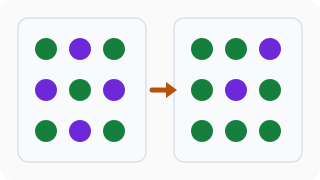
Tap an answer or press keys 1 to 4. Press Enter to continue after the explanation appears. Some questions ask you to order four stages. Others show a schematic population or ask you to work out a percentage. Its circles are illustrative; use the counts shown in the question. Browse more topics in the GCSE science games list.
The science behind natural selection
Variation means that individuals in a population have different characteristics. Some differences come from genes inherited from parents. Mutations can add new gene variants, and sexual reproduction mixes inherited genes in new combinations. Other differences come from the conditions in which an organism develops. Genes and the environment can both affect a characteristic, which biologists call a phenotype. Mutations change DNA. Most have no effect on phenotype. Some make a small difference, and a few can make a larger one. A changed trait may help in one environment and matter less in another. This is why examples need a stated selection pressure. The pressure is the part of the environment that changes an organism’s chance of survival or reproduction.
Natural selection can change which inherited variants are common. A population already has variation. A selection pressure, such as a change in food or surroundings, makes some variants more useful in that environment. Individuals with a useful inherited variant may be more likely to survive and reproduce. Their offspring can inherit that variant. Over many generations, it may become more common. The population changes as inherited characteristics shift. The Punnett Squares game gives more practice with genes and inheritance.
Antibiotic resistance shows natural selection in bacteria. A few bacteria may already carry a variant that helps them survive an antibiotic. The drug makes susceptible bacteria less likely to survive. Resistant bacteria may reproduce and pass on the resistance gene, so they become a larger share of the population. The antibiotic does not cause each bacterium to change because it needs to survive. The same process can be seen in many bacteria.
People can change populations in other ways. In selective breeding, people choose which plants or animals reproduce because they show a desired trait. They repeat this over generations. Genetic engineering changes an organism’s genome by adding a gene from another organism. Both are different from natural selection, where environmental pressures affect which variants survive and reproduce. These topics appear alongside evolution in the biology topic guide.
The wording here follows the AQA GCSE Biology specification, Edexcel GCSE Biology specification and OCR Gateway Biology specification.
Tips for natural selection questions
Keep variation, selection and evolution separate. Variation means differences in a population. Natural selection is the process that favours some inherited variants. Evolution is the change in inherited characteristics across generations. A variant may help in one set of conditions and matter less in another. Connect your answer to the environment described in the question.
For a sequence question, start with variants already in the population. Next identify the selection pressure. Then look for which organisms survive and reproduce. Finish with inheritance across generations. A need does not create a useful variation in an individual.
For antibiotic resistance, remember that the bacteria with a helpful variant are more likely to survive the drug. They pass the variant to offspring. The antibiotic selects among bacteria; it does not train them to resist it.
For a percentage, find the resistant survivors and all survivors. Add the resistant and other surviving counts to get the denominator. Divide the resistant count by that total and multiply by 100. For example, 12 resistant and 28 other survivors means 12 out of 40 survivors. The diagram is schematic, so do not count its circles.
Use this natural selection game in the classroom
After a question, ask a partner to explain which stage they used as evidence. For a natural selection sequence, say how the variant was already present, what pressure acted, which organisms reproduced and what changed in later generations.
Compare the moth and bacteria examples. Both show how an inherited variant can become more common when it helps survival and reproduction. The details differ: one uses a visual background example, and one follows an antibiotic in a bacterial population.
The population drawing is a teaching diagram, not a real survey. Use the printed numbers for percentage questions. To explore food webs and changing populations, try the KS3 Food Web Builder.
Similar games
Try Punnett Squares for inheritance, Pathogens and Disease for microbes, or KS3 Food Web Builder for populations and ecosystems.
Questions about natural selection
Use these answers to review the terms and processes in the game.
What is natural selection?
It is a process where individuals with inherited variants better suited to their environment are more likely to survive and reproduce. Their variant may become more common in later generations.
What is the difference between variation and evolution?
Variation means differences between individuals in a population. Evolution is a change in a population’s inherited characteristics over time.
Do antibiotics make bacteria become resistant?
Resistant variants can be present before an antibiotic is used. The drug makes susceptible bacteria less likely to survive. Resistant bacteria may then reproduce and pass on the variant.
How is selective breeding different from natural selection?
People choose which organisms reproduce in selective breeding. In natural selection, environmental pressures affect which variants are more likely to survive and reproduce.