How to play pH Detective
pH Detective is a free GCSE chemistry game about the pH scale, neutralisation and salts. It has three kinds of question, and they get harder as the round goes on.
The first three questions show three samples, A, B and C, each with a pH value on a scale from 0 to 14. You pick the order that runs from the most acidic sample to the most alkaline. Questions 4 to 7 name an acid and an alkali, and you pick the salt they make. From question 8, some questions ask what makes one acid stronger than another at the same concentration. The harder start skips the pH scale questions, so the strength questions can appear from question 4.
Every question has four options and a 15 second limit. A correct answer inside the limit is worth 15 points, and a question with no answer when time runs out is marked wrong. With practice mode on, the limit disappears and a correct answer is worth 10. If you choose a wrong option, the game shows the rule and the right answer.
The science behind the pH scale
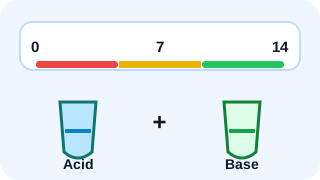
The pH scale measures how acidic or alkaline a solution is. It runs from 0 to 14. A solution with a pH of 7 is neutral. Below 7 it is acidic, and above 7 it is alkaline. You can measure pH with universal indicator, a dye that changes colour with pH, or with a pH probe. AQA covers this in 4.4.2.4 of 8462.
Acids make hydrogen ions, H⁺, when they dissolve in water. Alkalis make hydroxide ions, OH⁻. The more hydrogen ions in a solution, the lower its pH. Each step of one down the scale means ten times as many hydrogen ions, so a solution at pH 3 has ten times the hydrogen ion concentration of one at pH 4. This is a Higher Tier idea. AQA covers it in 4.4.2.6, Edexcel in point 3.5 of 1CH0, and OCR Gateway in C3.3j.
When an acid reacts with an alkali, the hydrogen ions and hydroxide ions join to make water: H⁺ + OH⁻ → H₂O. This is neutralisation. The other product is a salt. The first part of the salt's name comes from the metal in the alkali. The second part comes from the acid: hydrochloric acid makes chlorides, nitric acid makes nitrates and sulfuric acid makes sulfates. So sulfuric acid and potassium hydroxide make potassium sulfate and water. AQA sets out this naming rule in 4.4.2.2.
Strength and concentration are different ideas. A strong acid ionises completely in water, which means all of it splits into ions. A weak acid only partly ionises. Concentration is how much acid is dissolved in each unit of volume, and dilute means a low concentration. Hydrochloric, nitric and sulfuric acids are strong. Ethanoic, citric and carbonic acids are weak. At the same concentration, the stronger acid has the lower pH.
Strong and weak acids are Higher Tier. AQA marks them so in 4.4.2.6. Edexcel covers the two ideas in points 3.7 and 3.8, and OCR Twenty First Century in C6.1. OCR Gateway notes in C3.3 that many students treat strength and concentration as if they meant the same thing, which is the trap in the game's strength questions.
Tips for pH and salt questions
- For the order questions, find the lowest pH first. It is the most acidic, so it goes at the start.
- A pH of exactly 7 is neutral. It sits between the acids and the alkalis.
- To name a salt, take the metal from the alkali and the family name from the acid.
- Every acid and alkali in the game react to make a salt and water, so a salt always forms.
- Strength is about how much the acid ionises. Concentration is about how much acid is in the water. A strong acid can be dilute, and a weak acid can be concentrated.
In a strength question, three of the options describe concentration in different words. Only one describes ionisation.
Use pH Detective in the classroom
pH Detective suits Years 9 to 11. The pH scale questions also fit KS3, where the national curriculum covers the pH scale, indicators and neutralisation, so a Year 8 class can play the early part of a round.
Use the salt questions after a practical in which students make a salt. Ask them to write the word equation for each question before they choose. The strength questions work well as a single hinge question before a Higher Tier lesson on strong and weak acids: anyone who picks a concentration answer needs the idea explained again.
Practice mode removes the timer for students who need more thinking time. The page for teachers explains how to run the games in class without any sign-up.
Similar games
To balance the symbol equations for these same reactions, play Balance It. Higher Tier students can work out reacting masses for them in Mole Ratio Rush. Metals react with dilute acids, and you can rank them in Reactivity Rank. Rf Race covers chromatography, and the all games page lists every game.
Questions about pH and acids
Short answers to common questions about acids, alkalis and pH.
What does the pH scale measure?
It measures how acidic or alkaline a solution is, on a scale from 0 to 14. pH 7 is neutral, values below 7 are acidic and values above 7 are alkaline.
Which salt forms when an acid reacts with an alkali?
The metal in the alkali gives the first part of the name, and the acid gives the second. Hydrochloric acid makes chlorides, nitric acid makes nitrates and sulfuric acid makes sulfates. Water forms as well.
What is the difference between a strong acid and a concentrated acid?
A strong acid ionises completely in water. A concentrated acid has a lot of acid dissolved in each unit of volume. The two ideas are separate, so an acid can be strong and dilute, or weak and concentrated.
Is pH 1 ten times more acidic than pH 2?
A solution at pH 1 has ten times the hydrogen ion concentration of a solution at pH 2. Each drop of one on the pH scale multiplies the hydrogen ion concentration by 10. This is a Higher Tier idea.