How to play Photosynthesis Lab
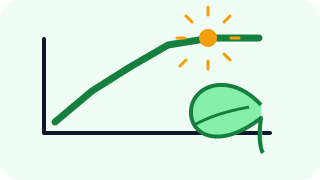
Photosynthesis Lab is a free GCSE biology game about the photosynthesis equation and the limiting factors of photosynthesis. Before you start, choose your exam board, and tick Higher tier if you sit that paper. Most questions show a graph of the rate of photosynthesis against light intensity, carbon dioxide concentration or temperature. A red ring marks one point on the line, and a short note describes the conditions. You pick the factor that limits the rate at that point.
Other questions ask you to build the word equation from tiles, in order, and to say whether photosynthesis is endothermic or exothermic. You also say where it happens and what the plant does with the glucose it makes. With Higher tier ticked, two of the later questions change. One asks about factors that work together, and one uses the inverse square law for a lamp. The harder start moves the equation and the quick facts to the front and adds more graphs.
If you choose AQA, the amount of chlorophyll is one of the answer options, because only AQA lists it as a limiting factor. For the other boards, that option says nothing limits the rate. The clock counts down from 15 seconds. A right answer scores 10, plus 5 if you beat the clock, and the practice switch hides the clock. Your best score is kept separately for Higher tier and for the harder start.
The science behind the photosynthesis equation
Plants and algae use light to turn carbon dioxide and water into glucose and oxygen. AQA prints the word equation as carbon dioxide + water → glucose + oxygen, with light written above the arrow. It lists the symbols CO₂, H₂O, O₂ and C₆H₁₂O₆ for you to recognise, but it does not join them into a balanced symbol equation. Edexcel describes the reaction in a sentence, and OCR J247 refers to the word equation without printing it.
Photosynthesis is endothermic, which means it takes in energy. AQA says light transfers energy from the surroundings to the chloroplasts. The chloroplasts in plant cells are where photosynthesis happens, and they contain chlorophyll.
A limiting factor is the one in shortest supply, which holds the rate back. Every board names temperature, light intensity and carbon dioxide concentration, and AQA adds the amount of chlorophyll. On a graph, the line rises while the factor on the axis limits the rate. When the line goes flat, something else limits it. Temperature behaves differently: the rate rises to a peak and then falls when it gets too hot for the enzymes.
At Higher tier, every board adds two ideas. The factors interact, so you may need to judge two or three of them on one graph. Light intensity also follows the inverse square law. It is inversely proportional to the square of the distance from the lamp, so double the distance and the intensity falls to a quarter.
The plant uses its glucose in several ways. AQA lists respiration, starch for storage, fats and oils for storage, cellulose for cell walls and amino acids for proteins. OCR J257 gives a similar list.
AQA 8461 and 8464 cover this in 4.4.1.1 to 4.4.1.3. Edexcel 1BI0 and 1SC0 have it in 6.1 to 6.6, OCR J247 in B1.4 and OCR J257 in B3.1. In KS3 science you learn a word summary of photosynthesis, and limiting factors come later, at GCSE.
Tips for limiting factors of photosynthesis
- If the line is still rising at the marked point, the factor on the axis is the limiting one.
- If the line is flat, read the note about conditions. The factor it says is low is the limiting one.
- On a temperature graph, a point past the peak means temperature limits the rate.
- Build the equation left to right: carbon dioxide + water, then the arrow, then glucose + oxygen.
- Lactic acid and ethanol come from respiration. Leave them in the bank.
For the inverse square law, square the change in distance and divide by the result. Three times the distance gives one ninth of the intensity.
Use this in the classroom
Photosynthesis Lab suits Years 9 to 11 when you teach photosynthesis or revise bioenergetics. Set the exam board on the start screen so the chlorophyll question matches the course your students take.
Show one graph on the board and cover the note about conditions. Ask the class what they can say from the line alone, then reveal the note. A flat line tells you which factor is not limiting, and students need the note to say which one is. AQA's required practical and Edexcel's core practical both measure how light intensity affects the rate, so the light graph fits well in that lesson.
Use the Higher tier option with students who sit the Higher paper. The inverse square question pairs well with a lamp and a ruler. Move the lamp twice as far away and ask the class what happens to the light.
The practice switch turns the clock off. Students do not sign in, and the what we collect page says what the site stores. The page for teachers has more ideas for lessons.
Similar games
Plants use some of their glucose in respiration, which you can build in Respiration Equations. To place the chloroplasts in a plant cell, try Cell Builder. For more practice at reading graphs, Motion Graphs uses distance-time graphs. The all games page has the full list.
Questions people ask
Students and teachers often ask these questions about photosynthesis.
What is the word equation for photosynthesis?
Carbon dioxide + water → glucose + oxygen. AQA prints it with light written above the arrow, because the reaction needs light.
What are the limiting factors of photosynthesis?
Every GCSE board names temperature, light intensity and carbon dioxide concentration. AQA also lists the amount of chlorophyll. The factor in shortest supply sets the rate.
Is photosynthesis endothermic or exothermic?
Endothermic. It takes in energy, which light transfers from the surroundings to the chloroplasts.
How does the inverse square law affect photosynthesis?
Light intensity is inversely proportional to the square of the distance from the light. If you move a lamp twice as far away, the intensity falls to a quarter, so the rate can fall too. Every board puts this in the Higher tier.