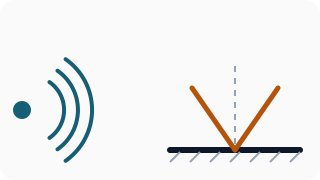
How to play Light and Sound
Light and Sound is a free KS3 physics game about light and sound waves. A wave carries energy from place to place. A round has ten questions in three steps.
Questions 1 to 3 are quick facts about sound and light. Questions 4 to 7 show two sound traces, marked A and B. A trace is a picture of a sound wave, like the line a microphone draws on a screen. You pick the louder sound, or the one with the higher pitch. Questions 8 to 10 show a ray of light hitting a flat mirror. You give the angle of reflection. Tick Harder start to skip the facts. You then begin with the traces and reach the mirror at question 4.
A right answer scores 10 points. Answer inside 15 seconds and you get 5 more. When the bonus clock runs out, you can still answer for 10. Practice mode turns the clock off. On a keyboard, keys 1 to 4 pick an answer and Enter moves you on. After each answer, a short note explains the right one.
The science behind light and sound
Every sound starts with a vibration. A guitar string, a drum skin or the cone of a loudspeaker moves quickly back and forth. Each movement pushes on the air next to it. The push passes from particle to particle, and the sound wave spreads out. The particles move back and forth along the line the wave travels. Scientists call this kind of wave longitudinal.
Sound needs particles to pass it on, so it needs a medium. A medium is any material, such as air, water or a solid. A vacuum has no particles, so sound cannot cross it. That is why space is silent. Sound travels at about 340 metres per second in air. It moves faster in water, and faster again in most solids.
When a sound reaches you, it makes your eardrum vibrate. A microphone works in a similar way, with a thin sheet called a diaphragm. The number of vibrations each second is the frequency, measured in hertz (Hz). A high frequency gives a high pitch. The size of each vibration is the amplitude, and a bigger amplitude sounds louder. Your auditory range is the range of frequencies you can hear. For a young person it runs from about 20 Hz to 20,000 Hz. Dogs and bats can hear much higher sounds than people can.
Hard surfaces reflect sound, and you hear the reflection as an echo. Soft things, such as curtains and carpets, absorb sound. Light needs no medium at all. It crosses the vacuum of space to reach us from the Sun. It is also far faster than sound, at about 300,000 kilometres per second. So you see lightning before you hear the thunder.
Light travels in straight lines, which we draw as rays. When a ray hits a mirror, it follows the law of reflection. The angle of reflection equals the angle of incidence. You measure both from the normal, a line drawn at right angles to the mirror. When light passes at an angle from air into glass, it changes direction. We call this refraction. A prism splits white light into a spread of colours, because each colour bends by a different amount.
The game follows the waves part of the KS3 National Curriculum for science in England. It covers sound waves, light waves, the speed of light and the ray model for mirrors. For wave speed sums at GCSE, Wave Lab is the next step.
Tips for light and sound questions
- Loud means tall. Compare how high each trace rises above its middle line.
- High pitch means squashed up. The trace with more waves across the screen has the higher frequency.
- Check height and spacing on their own. A trace can be loud and low, or quiet and high.
- In a mirror question, find the dashed normal first. The angles start from it, and never from the mirror.
- If an answer and the given angle add up to 90°, that answer was measured from the mirror. Rule it out.
- Sound needs particles and light does not. That one fact knocks out lots of wrong answers.
A wrong answer resets your streak. If the clock rushes you, turn on practice mode and take each question slowly.
Use this light and sound game in the classroom
Light and Sound suits Years 7 to 9 in lessons on sound, light or waves. A round of ten takes about five minutes. It works as a starter or a quick end check.
Before the trace step, plug a microphone into a laptop and show a sound trace on the board. Hum quietly, then loudly, then on a higher note. Ask the class what changes on the screen each time. Then play the trace questions together.
The mirror step fits well after a practical with a ray box and a flat mirror. Pupils draw the normal, measure both angles with a protractor and compare them. Then they test the rule in the game. Ask them why the answer that adds up to 90° is wrong.
For a KS3 physics revision lesson, pair this game with Force Sort. Nobody signs in to play, and what we collect explains what the site stores. You can find more lesson ideas on our teachers page.
Similar games
Sound travels by passing a push from particle to particle. Solid, Liquid, Gas shows how those particles sit in each state, which helps explain why sound moves fastest in solids. The KS3 games page lists every game for Years 7 to 9.
Questions about light and sound
Short answers to common questions about sound, light and mirrors at KS3.
What do students need to know about light and sound in KS3 science?
For sound, KS3 science covers how vibrations make sound and why sound needs a medium. It also covers frequency in hertz, echoes and the range of sounds that people and animals can hear. For light, it covers travel through a vacuum, the speed of light, reflection in mirrors, refraction and how a prism splits white light into colours.
How do you tell which sound is louder from a waveform?
Look at the amplitude, which is the height of the wave above its middle line. The taller trace is the louder sound. The number of waves on the screen shows the frequency, and so the pitch. More waves in the same time means a higher pitch.
What is the law of reflection?
The angle of reflection equals the angle of incidence. Both angles are measured from the normal. The normal is a line drawn at 90° to the mirror, at the point where the ray hits it. A common mistake is to measure from the mirror surface instead.
Why can light travel through space but sound cannot?
Sound is a vibration passed from particle to particle, so it needs a medium such as air, water or a solid. Space is almost empty, with no particles to pass the vibration on. Light needs no medium, so it crosses space from the Sun to Earth.